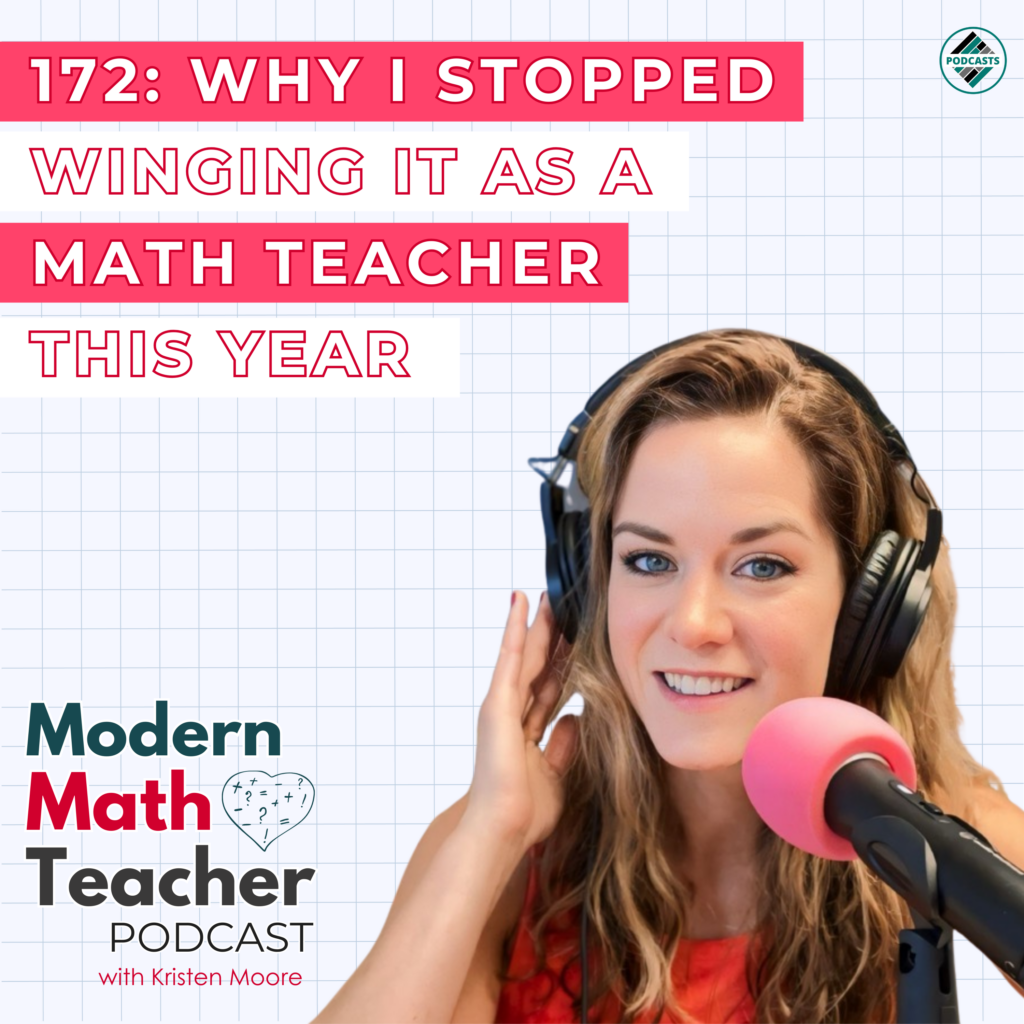
I used to think I could wing it.
Not completely, of course. I still lesson planned. I cared deeply about my students and what they were learning. But after teaching the same content for several years, I developed a level of confidence that came from experience.
I knew where lessons were headed, what misconceptions students were likely to have, and how to explain concepts when students got stuck.
And honestly, I thought that was enough, but this year showed me it wasn’t.
Between piloting a brand-new curriculum, teaching both co-taught and traditional Algebra 2 classes, and beginning the process of National Board Certification, I found myself thinking about teaching differently than I ever had before.
I stopped asking, “How do I get through this lesson?” and started asking, “What experience are my students actually having during this lesson?”
That shift changed everything.
Knowing Math Is Not the Same as Designing Learning
One of the biggest lessons I learned this year is that knowing mathematics and designing mathematical experiences are two very different skills.
I’ve taught a lot of math over the years. Algebra 1. Geometry. Algebra 2. Intervention courses. I’ve always had a pretty strong understanding of how concepts connect and where students are headed next.
That content knowledge matters. It gives us confidence. It helps us anticipate misconceptions and respond when students get stuck.
But confidence can sometimes trick us into thinking good teaching will naturally happen.
This year reminded me that good teaching is intentionally designed.
Students do not experience lessons the same way teachers do. A lesson that makes perfect sense in my head can still leave students confused, disengaged, or unsure of why they’re learning it.
The more I reflected on my practice this year, the more I realized that effective teaching is about much more than delivering content. It’s about creating experiences that help students make sense of that content.
The Curriculum Pilot Changed My Thinking
This year, our district piloted the Illustrative Mathematics curriculum.
If you’ve ever implemented a new curriculum, you know that there is always a learning curve. This curriculum is deeply inquiry-based, which meant students were expected to explore ideas, discuss their thinking, and build understanding through problem-solving experiences.
That was new for many of my students.
In some ways, it was new for me too.
What I learned very quickly was that I couldn’t simply follow the lesson as written and expect it to work perfectly for every class. Not because the curriculum wasn’t strong, but rather because teaching is responsive work.
Every class has its own personality. Every group of students brings different strengths, needs, and experiences into the room. What worked beautifully during one class period sometimes needed adjustments for the next.
That realization pushed me to become much more intentional.
I wasn’t just planning what I was teaching anymore. I was thinking carefully about how students would experience the lesson.
I Stopped Planning Around What I Was Doing
This was probably the biggest shift of all.
For years, a lot of my planning focused on what I was going to do during a lesson.
- What questions would I ask?
- What examples would I show?
- What notes would students take?
This year, I started planning around what students needed to experience.
That changed the way I thought about pacing. It changed how I structured discussions. It changed how I grouped students and how I built routines into my classroom.
Even small decisions became intentional.
- Brain breaks were no longer random pauses in learning. They became opportunities to reset attention and improve focus.
- Turn-and-talk moments became a way for students to process ideas before sharing publicly.
- Whiteboards became tools for making student thinking visible.
- Exit tickets weren’t just something I used at the end of class. Sometimes they became checkpoints in the middle of a lesson to help me understand where students were and what they needed next.
None of those decisions were random anymore.
They became instructional design choices.
And honestly, that made teaching feel more intellectual again.
My Understanding of Differentiation Changed
Another shift happened in the way I think about differentiation.
For a long time, I thought differentiation meant different assignments, different levels of support, or different pathways through content.
Sometimes it does.
But this year helped me realize something deeper.
You can differentiate class to class. (And honestly, you probably should.)
Every class period has its own dynamic. Some groups need more discussion, or more structure. Some need more movement. Others need additional processing time before they’re ready to share their thinking.
Trying to force every class to look exactly the same doesn’t always serve students well.
Once I gave myself permission to respond to the actual humans sitting in front of me, my teaching improved. Each class became its own experience instead of simply repeating the same lesson multiple times throughout the day.
That shift not only benefited my students, it made teaching more enjoyable for me too.
Rigor and Support Can Exist Together
This year also pushed me to think differently about rigor.
I want students to think deeply, to struggle productively, and to make sense of mathematics instead of simply memorizing procedures.
But I also realized that there is a difference between productive struggle and frustration.
Struggle is part of learning.
Too much struggle feels like drowning.
That distinction matters.
As a result, I became much more intentional about the supports I built into my classroom. Learning targets, discussion structures, checkpoints, reflection tools, and feedback loops all became part of helping students engage in rigorous thinking.
Those supports are not a replacement for rigor.
They make rigor possible.
I think we sometimes act as though support and challenge are opposites. The best classrooms I’ve seen have both.
Students need opportunities to think deeply, but they also need structures that help them stay engaged in that thinking.
The Most Surprising Lesson
The thing I didn’t expect this year was how much I would learn.
There were concepts I’ve taught before that suddenly made more sense to me than they ever had when I was a student.
Topics like transformations, inverse relationships, sequences, and complex numbers started to feel less like procedures and more like stories.
I found myself becoming fascinated by the evolution of mathematics itself.
- Why do complex numbers exist?
- Why did we expand the number system?
- What problem were mathematicians trying to solve?
The deeper I dug into those questions, the more connected everything became.
Instead of teaching isolated skills, I felt like I was helping students understand the bigger story of mathematics.
That’s one of the things that reignited my excitement for teaching this year.
Becoming More Intentional
If this year taught me anything, it’s that teaching math is deeply intellectual work. It wasn’t because we know all the answers, but rather because we’re constantly analyzing, adjusting, designing, reflecting, and responding.
Becoming more intentional didn’t make me a perfect teacher. I still had lessons that didn’t go as planned. I still had moments where I needed to pivot, rethink, and try again. But it did make me a more thoughtful teacher. And I think that matters.
This year reminded me that great teaching isn’t about knowing the content well enough to wing it.
It’s about intentionally designing experiences that help students engage with that content in meaningful ways.
That’s the work that moves learning forward.
And it’s the work I’m excited to keep doing.
If you’re trying to think more intentionally about when to use projects, performance tasks, or practice in your classroom, I’ve created a free guide to help.
You can grab it here:
https://moorethanjustx.myflodesk.com/practice
Until next time, keep it real.
 Listen & Connect
 Listen to the episode: https://www.buzzsprout.com/2187419/episodes/19188336
 Instagram: @moorethanjustx
 Join the free FB group: The Modern Math Teacher Community
 Become a Modern Math Teacher Member
 Explore more resources: www.moorethanjustx.com