There was a time when it felt like every education conference, professional development session, and classroom bulletin board had the words growth mindset somewhere on display.
Then the conversation shifted. New initiatives came along, different buzzwords took center stage, and growth mindset slowly faded into the background.
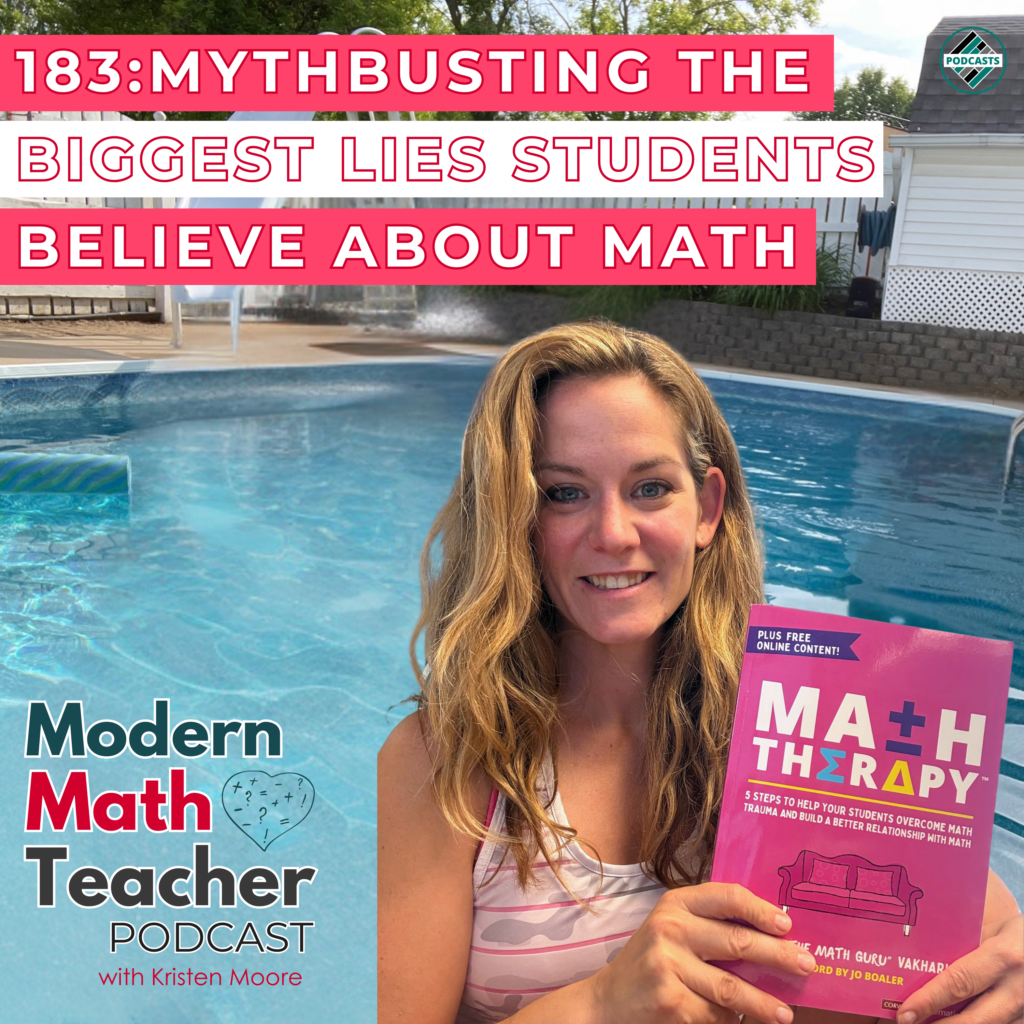
Reading Chapter 3 of Math Therapy by Vanessa Vakharia made me wonder if we stopped talking about it before we finished doing the work.
Because at the heart of math therapy is a simple but powerful truth: students can’t build a healthier relationship with mathematics if they continue believing unhealthy things about themselves.
What Does It Mean to Be Good at Math?
One question from this chapter has stayed with me:
What does it actually mean to be good at math?
If you asked your students, many would probably say it means getting the right answer quickly, memorizing formulas, finishing first, or never making mistakes.
Those answers make sense. They’re the messages students have absorbed for years.
My definition looks very different.
Being good at math means recognizing patterns, making connections, choosing a strategy, and making sense of a problem. It means asking good questions and explaining your thinking, even when the path isn’t obvious.
Accuracy matters, but thinking matters more.
When students define mathematical success only by speed and correctness, many will decide they simply aren’t “math people” long before they’ve had a chance to develop real mathematical reasoning.
Growth Mindset Isn’t Something You Hang on the Wall
One of the things I appreciated most about this chapter is that it moves beyond the slogan version of growth mindset.
Adding the word yet to a sentence isn’t enough.
Neither is hanging a poster in the classroom.
Students don’t develop a growth mindset in math because we tell them they can grow.
They develop one because they experience growth for themselves.
Think about the progression:
- A student struggles with a challenging problem.
- They stick with it.
- Eventually, something clicks.
- That success becomes evidence.
Over time, enough evidence begins to reshape what they believe about themselves.
Beliefs built on experience are much harder to dismiss than beliefs someone simply tells us to have.
Productive Struggle Is the Bridge
This chapter kept bringing me back to a Lunch and Learn I recently hosted on productive struggle.
The two ideas fit together almost perfectly.
- Without struggle, students don’t experience growth.
- Without growth, they don’t collect evidence that they are capable.
- Without that evidence, it’s difficult to change the stories they’ve been telling themselves about mathematics.
The goal isn’t to remove the challenge from math class.
The goal is to help students discover that they can work through challenging mathematics and come out stronger on the other side.
That’s where confidence starts to grow.
Your Brain Notices What You Tell It to Notice
One concept Vanessa introduces is the Reticular Activating System (RAS), which she compares to a social media algorithm.
The comparison immediately made sense.
Scroll through videos about gardening for a few days, and suddenly your entire feed seems filled with plants.
Start shopping for a particular vehicle, and it feels like everyone on the road owns one.
Those things were always there. You simply started noticing them.
Students do something similar.
When a student believes they’re bad at math, every mistake becomes more proof that the belief is true. Every incorrect answer reinforces the story they’ve already accepted.
What if we intentionally helped students notice different evidence?
- Evidence of persistence.
- Evidence of improvement.
- Evidence that they can learn something difficult.
That shift in attention may be one of the most powerful forms of mythbusting we can offer.
Reflection Helps Students See Their Growth
Another part of this chapter that resonated with me was the emphasis on reflection.
Last year, my intervention students regularly completed math journals. Looking back, the writing itself wasn’t the most valuable part. The real value came from slowing down long enough to notice growth.
Students began recognizing strategies they were using, mistakes they had corrected, and moments where concepts finally made sense.
Those reflections became evidence.
That’s also why I continue to use Favorite Mistakes in my classroom.
Mistakes aren’t something to hide.
They’re opportunities to examine thinking, make connections, and celebrate learning in progress.
When students begin viewing mistakes as information instead of failure, their relationship with mathematics starts to change.
The Biggest Lesson I’m Taking Away
If I had to summarize this chapter in one sentence, it would be this:
Students don’t need more motivational posters.
They need more opportunities to experience success after meaningful effort.
That’s how limiting beliefs begin to change.
That’s how students build confidence.
And that’s how they start rewriting the stories they’ve believed about themselves for years.
Reflection Questions
As you think about your own classroom, consider these questions:
- What does it mean to be good at math?
- Would your students answer that question the same way you would?
- What evidence are your students collecting about themselves each day?
- More importantly, what evidence are they actually noticing?
This week, try intentionally noticing moments of growth in your classroom. It might be a student persevering through a difficult problem, making a thoughtful connection, or explaining an idea more clearly than they could a month ago.
Those moments are worth celebrating because they’re the moments that reshape identity.
Join Our Math Therapy Book Study
Throughout July, we’re reading Math Therapy by Vanessa Vakharia together and discussing one chapter each week on the podcast.
Each episode explores the ideas that stand out most, connects them to real classroom practice, and invites you into the conversation.
If you’re reading along, I’d love to hear your answer to this week’s question:
What does it really mean to be good at math?
Come share your thoughts inside our Facebook community, and join us next week as we continue exploring the Five Ms framework.
 Physical Book: https://amzn.to/42VJRl6
 Audiobook: https://amzn.to/49nV55D
It’s never too late to jump into our summer book study!
 Listen & Connect
Listen to the episode: https://www.buzzsprout.com/2187419/episodes/19430500
 Instagram: @moorethanjustx
 Join the free FB group: The Modern Math Teacher Community
 Become a Modern Math Teacher Member
 Explore more resources: www.moorethanjustx.com