There is one question every math teacher has heard more times than they can count…
“When am I ever going to use this?”
For years, we’ve been trained to answer that question with real-world examples.
- “You’ll use this if you become an engineer.”
- “Architects use this.”
- “Scientists use this.”
Those answers aren’t wrong.
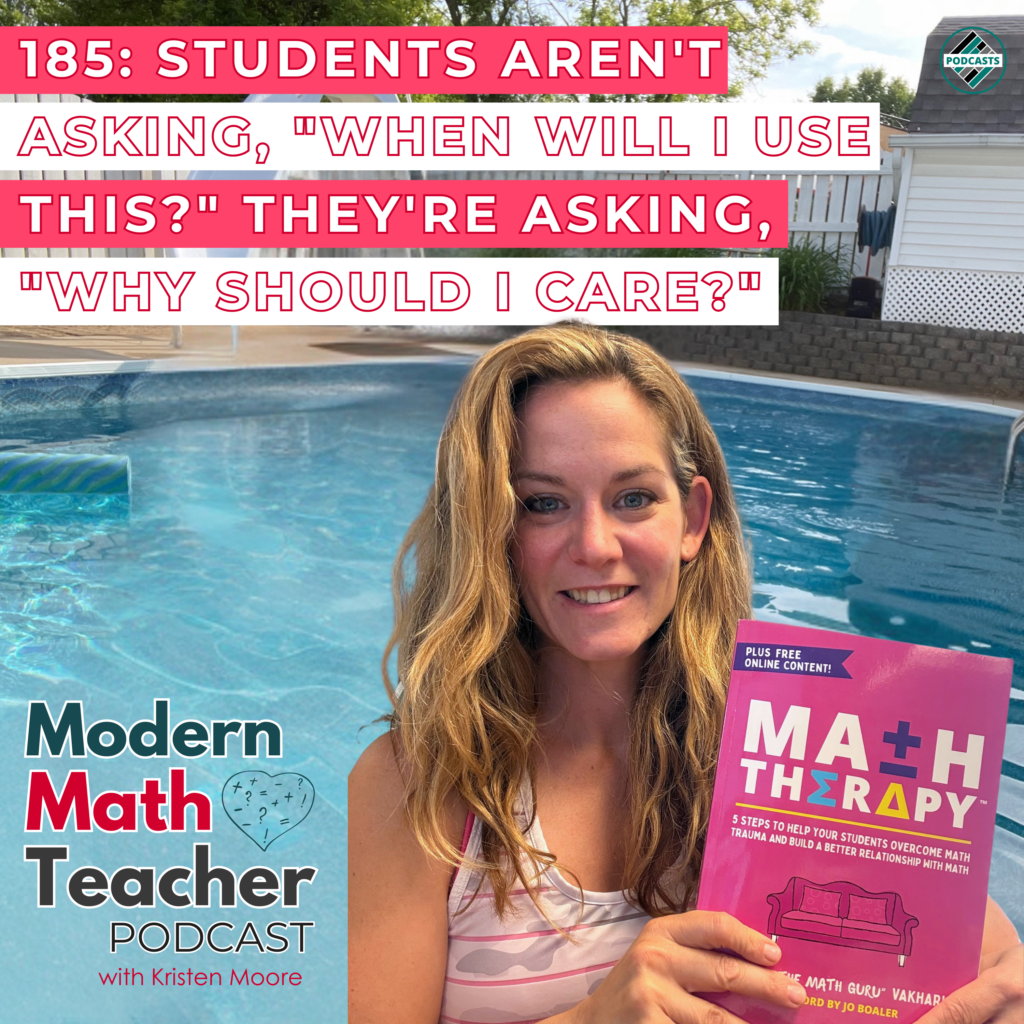
But after reading Chapter 5 of Math Therapy by Vanessa Vakharia, I started wondering if we’ve been answering the wrong question all along.
Maybe students aren’t really asking, When will I use this?
Maybe they’re asking something much deeper…
Why should I care?
That small shift completely changes the conversation.
Student Motivation in Math Starts With Meaning
One of my favorite parts of this chapter is Vanessa’s reminder that most students aren’t unmotivated.
They’re disconnected from the purpose.
As teachers, it’s easy to assume a student who isn’t engaged simply doesn’t care about learning. But many students care deeply. They just don’t see why today’s lesson matters to them.
When students discover meaning, motivation often follows.
That’s why I believe improving student motivation in math isn’t about making every lesson more entertaining.
It’s about helping students connect with the purpose behind what they’re learning.
Real Doesn’t Always Mean Relevant
If you’ve followed my work for any length of time, you’ve probably heard me talk about my three Rs:
- Real
- Relevant
- Rigorous
This chapter reminded me why those first two words aren’t interchangeable.
A lesson can be completely rooted in the real world and still feel irrelevant to students.
Calculating a mortgage payment?
Absolutely real.
Helpful for adults.
Probably not something a fourteen-year-old is excited to solve.
Instead of asking, “How can I make this real?” I’ve started asking a different question.
How can I make this meaningful?
Sometimes relevance comes from the context.
Other times it comes from the thinking students are doing.
Both matter.
The Skills Students Will Actually Use
It’s easy to focus on the content standards because that’s what we teach every day.
Students might be learning systems of equations, exponential functions, or angle relationships.
But they’re learning something bigger at the same time.
They’re learning how to:
- reason through unfamiliar situations
- analyze information
- defend their thinking
- recognize patterns
- communicate ideas clearly
- persevere when they don’t immediately know the answer
Those are transferable skills.
Those are life skills.
Long after students forget specific formulas, they’ll still need to solve problems, evaluate information, and explain their reasoning.
Sometimes that’s the best answer to the question, “Why should I care?”
Maybe We Need to Redefine Math
One idea from this chapter that kept coming back to me was Vanessa’s invitation to rethink what mathematics actually is.
Ask students to define math, and you’ll probably hear answers like:
- Numbers
- Formulas
- Equations
- Getting the right answer
My definition has changed over the years.
Mathematics is reasoning.
It’s making sense of situations.
Looking for patterns.
Asking good questions.
Communicating ideas.
It’s just as much about thinking as it is about calculating.
When students begin seeing math this way, the subject feels much bigger than memorizing procedures.
Success Doesn’t Look the Same for Everyone
Another section that really stood out focused on redefining success.
Last year, I asked my Geometry Proficiency Lab students a simple question.
What does success mean to you?
Their answers surprised me.
One student wanted to pass Geometry.
Another wanted to ask one question each week.
Someone else simply wanted to stop feeling anxious before quizzes.
None of those goals looked the same.
That’s what made them meaningful.
Success isn’t always earning an A.
Sometimes success is believing you’re capable of doing something you couldn’t do yesterday.
Giving students ownership over that definition can completely change how they approach learning.
Accountability Helps Students Keep Going
When Vanessa introduced accountability buddies, I wasn’t immediately convinced.
Then I thought about my own life.
Whenever I commit to a fitness goal, I usually find someone to check in with.
During National Board Certification, my cohort kept me moving forward.
Even this podcast has become an accountability system because every week I know you’re listening, learning, and reflecting alongside me.
Why wouldn’t students benefit from that same kind of support?
This fall, I’m planning to pair students in Geometry Proficiency Lab with accountability partners who share the same Geometry teacher.
The goal isn’t competition.
It’s encouragement.
Learning is easier when someone is walking alongside you.
Feedback Builds Confidence
Another idea that connected with me was Vanessa’s discussion about feedback.
National Board Certification completely changed how I think about responding to student work.
Instead of writing:
“Good job.”
I want students to hear things like:
- “I noticed you tried a second strategy.”
- “You explained your reasoning more clearly today.”
- “You caught your own mistake before anyone pointed it out.”
- Specific feedback gives students something incredibly valuable.
Evidence.
Evidence that they’re growing. improving, and can do difficult things.
Technology has made grading much faster.
But it has also reminded me that the work I choose to collect deserves meaningful feedback.
If students are investing their time, I want my comments to move their learning forward, not simply tell them whether they were correct.
My Biggest Takeaway
If I had to summarize this chapter in one sentence, it would be this:
Students aren’t asking, “When will I use this?” They’re asking, “Why should I care?”
Sometimes the answer is a real-world application.
Or, the habits they’re developing.
Sometimes it’s the confidence they’re building.
Or, it’s the person they’re becoming.
Helping students discover that purpose may be one of the most powerful ways to strengthen student motivation in math.
Reflection Questions
As you think about your own classroom, consider these questions:
- How would your students define mathematics?
- Would their definition match yours?
- The next time a student asks, “When am I ever going to use this?” what purpose might they actually be searching for?
- How are you helping students see who they’re becoming while they learn mathematics?
One idea I’m taking into the new school year is this:
Students don’t always need another real-world example.
Sometimes they simply need to understand why today’s learning matters to the person they’re becoming.
That’s where motivation begins.
Join Our Math Therapy Book Study
Throughout July, we’re reading Math Therapy by Vanessa Vakharia together and discussing one chapter each week on the podcast.
Each episode explores the ideas that stand out most, connects them to real classroom practice, and invites you into the conversation.
If you’re reading along, I’d love to hear your answer to this week’s question:
What does it really mean to be good at math?
Come share your thoughts inside our Facebook community, and join us next week as we continue exploring the Five Ms framework.
 Physical Book: https://amzn.to/42VJRl6
 Audiobook: https://amzn.to/49nV55D
It’s never too late to jump into our summer book study!
 Listen & Connect
Listen to the episode: https://www.buzzsprout.com/2187419/episodes/19430513
 Instagram: @moorethanjustx
 Join the free FB group: The Modern Math Teacher Community
 Become a Modern Math Teacher Member
 Explore more resources: www.moorethanjustx.com