One of the biggest misconceptions about productive struggle is that if students are struggling, they’re learning.
I don’t think that’s always true.
There’s a difference between the discomfort that comes from thinking through a challenging problem and the fear that comes from worrying you’ll look foolish if you get it wrong.
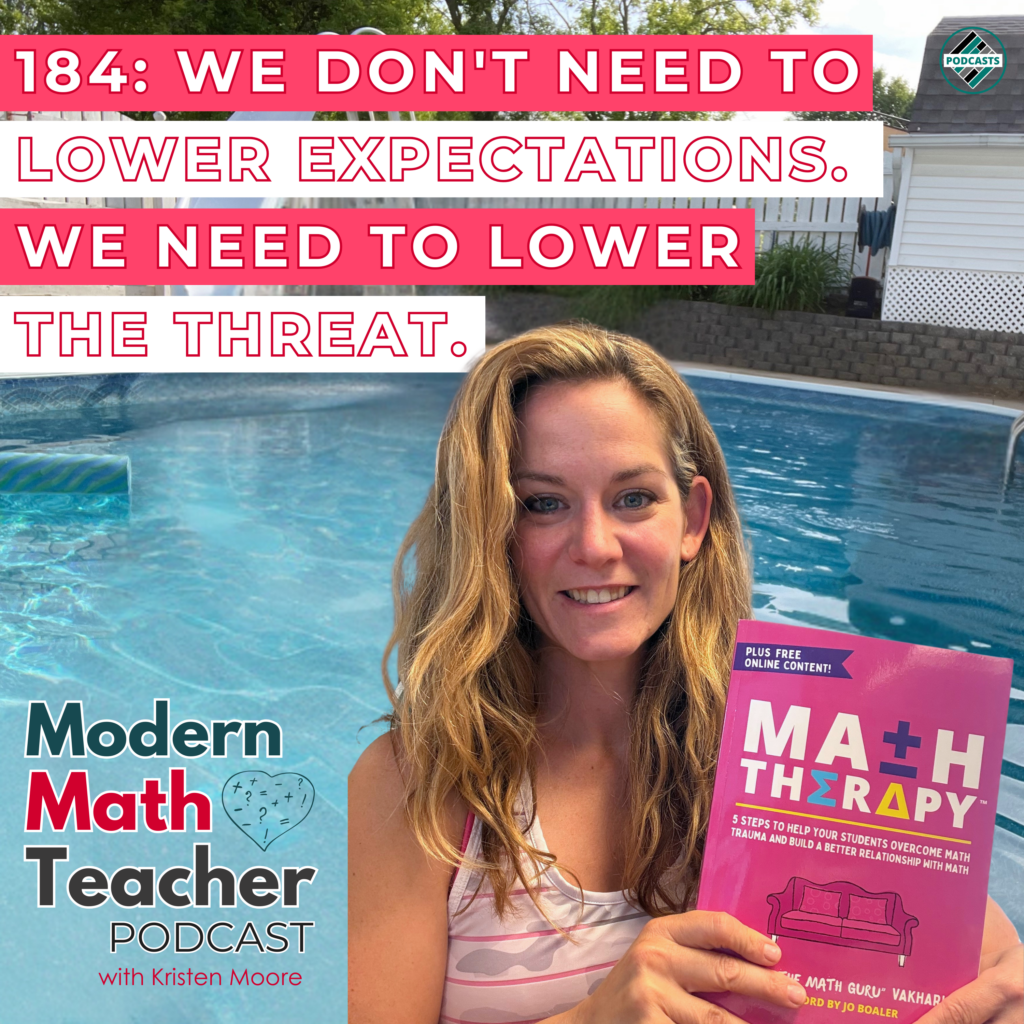
As I read Chapter 4 of Math Therapy by Vanessa Vakharia, I found myself reflecting on that distinction. The chapter is called Moderate, and while I wasn’t initially sure what that meant, the message became clear very quickly.
The goal isn’t to remove challenge from mathematics, it is to reduce the emotional threat that prevents students from engaging with that challenge in the first place.
That idea has changed how I’m thinking about productive struggle, classroom culture, and the learning environment I want to create this year.
What Does “Moderate” Mean?
Vanessa describes moderation in three ways.
- First, we help students recognize where math anxiety or math trauma shows up.
- Next, we give them tools to manage those emotions.
- Finally, we help them respond differently so those feelings don’t control their learning.
I appreciate this approach because it doesn’t pretend discomfort will disappear. Learning mathematics requires students to wrestle with uncertainty. They’ll make mistakes, revise their thinking, and spend time feeling stuck.
Those experiences aren’t problems to eliminate.
They’re part of learning.
The challenge is making sure that productive struggle doesn’t become overwhelming anxiety.
When students feel embarrassed, ashamed, or convinced they’ll fail before they even begin, meaningful learning becomes much harder.
My Own Math Story
One of the reflection prompts in this chapter asks teachers to examine their own experiences with mathematics.
At first, I didn’t think I had much to write about.
I’ve always enjoyed math, and I’ve been successful in it for most of my life.
Then I started remembering.
In Honors Geometry, we completed a project where we built a three-dimensional polyhedron. My angle calculations were slightly off, which meant the finished model didn’t fit together correctly. The project lowered my grade more than I expected, and I was devastated.
Looking back, the difficult part wasn’t the geometry.
It was what that experience meant to me.
I had built part of my identity around being the student who earned high grades. One project challenged that identity enough that I decided not to continue in the honors sequence the following year.
Years later, I encountered another challenge in Linear Algebra.
If you’ve taken that course, you’ve probably wrestled with eigenvalues and eigenvectors, too.
It was the hardest math class I’d ever taken. I passed, but not with the grade required for my major, so I had to repeat the course.
Those moments shaped the way I saw myself as a learner.
Reading this chapter reminded me that math trauma doesn’t only affect students who have always struggled.
Sometimes it affects students who believe they’re never supposed to struggle.
Productive Struggle Requires Psychological Safety
This idea kept bringing me back to something I talk about often: productive struggle.
Students need opportunities to grapple with difficult mathematics. They need time to reason through problems, test ideas, make mistakes, and revise their thinking.
None of that has changed.
What this chapter challenged me to consider is the environment surrounding those moments.
- Can students admit they don’t know the answer?
- Can they ask a question without worrying about how they’ll be perceived?
- Can they contribute an idea that’s only partially correct?
If the answer is no, then students aren’t just managing the mathematics.
They’re managing the fear that comes with participating.
That’s a very different experience.
Psychological safety isn’t the opposite of rigor.
It’s often what makes rigorous learning possible.
Rethinking Participation
One section of the chapter made me pause and reflect on one of my own teaching practices: cold calling.
I believe every student deserves to be part of mathematical conversations. I don’t want participation limited to the same few volunteers every day.
At the same time, Vanessa discusses how public embarrassment can contribute to math trauma.
That raised an important question for me.
Not whether I should stop inviting students to participate, but whether I’ve created a classroom where participating feels safe.
Over the years, I’ve built routines that give students options. They can ask for more thinking time, invite a classmate to build on their idea, or simply say they aren’t ready yet.
Those choices matter.
This year, I also want to spend more time using low-risk thinking routines like Notice and Wonder, Which One Doesn’t Belong?, and Same and Different.
These routines allow every student to contribute without the pressure of finding the one correct answer. Students begin experiencing success in mathematical conversations before they’re asked to defend more complex reasoning.
That progression builds confidence over time.
The Labels Students Carry
Another section that resonated with me focused on labels.
As I look ahead to next year, I realize nearly every class I’ll teach includes students who carry some type of label.
Some students are enrolled in Honors Algebra 2.
Others are taking Geometry Proficiency Lab.
Those labels communicate something before I ever introduce myself.
Students in intervention settings often believe they’re behind.
Students in honors classes often believe they’re expected to understand everything immediately.
The labels may be different, but they can create similar pressure.
One group worries they aren’t capable.
The other worries they’ll disappoint everyone if they aren’t perfect.
Neither mindset supports learning.
The work isn’t removing every label, rather, it is helping students rewrite the stories attached to those labels.
Belief Comes Before Growth
Throughout Math Therapy, Vanessa returns to a framework that continues to stick with me:
Believe.
Behave.
Become.
The more I think about it, the more I see that progression reflected in my own classroom goals.
Students first need opportunities to change what they believe about themselves.
Those new beliefs influence how they approach challenges.
Over time, those repeated experiences shape the kind of learner they become.
That’s why reflection, journaling, goal setting, and classroom discussion have become such important parts of my instruction.
They’re not separate from mathematics.
They’re supporting the mathematical identity students are building.
You Don’t Have to Do Everything
One thing I appreciated about this chapter is that it offers many possible strategies without suggesting every teacher should use all of them.
Some teachers naturally incorporate mindfulness exercises.
Others emphasize calming routines before assessments.
Some use breathing exercises or visualization.
Those approaches are wonderful.
They also aren’t the only way to help students moderate math anxiety.
For me, reflection feels authentic.
Favorite Mistakes feels authentic.
Goal setting feels authentic.
Those are the practices I want to strengthen because they align with the teacher I already am.
That was an encouraging reminder.
Supporting students doesn’t require becoming someone else.
It requires becoming a more intentional version of yourself.
The Classroom Agreement I’m Most Excited About
If there’s one idea I’m most excited to implement this year, it’s creating a Math Therapy Classroom Agreement.
I’ve used classroom agreements for years through Capturing Kids’ Hearts, and Illustrative Mathematics begins by building a math community together.
Reading this chapter helped me realize those ideas naturally fit within the Math Therapy framework.
This year, I plan to combine those approaches into one living document.
Not something students sign on the first day and never revisit.
Something we return to throughout the year as we continue building trust, belonging, and shared expectations.
Because classroom culture isn’t established in August.
It’s built every day.
Final Thoughts
One sentence kept coming back to me while reading this chapter:
We don’t need to lower expectations, we need to lower the threat.
Students deserve challenging mathematics.
They deserve opportunities to think deeply, persevere, and experience productive struggle.
They also deserve classrooms where mistakes aren’t embarrassing, questions are welcomed, and growth feels possible.
When students feel safe enough to take intellectual risks, productive struggle becomes exactly what it’s supposed to be:
A pathway to deeper understanding, greater confidence, and a healthier relationship with mathematics.
Reflection Questions
As you prepare for the new school year, consider these questions:
- What labels do your students bring into your classroom?
- How do those labels influence the stories they tell themselves?
- What routines help students feel safe enough to participate?
- Where can you reduce emotional threat without lowering academic expectations?
Creating a classroom where students feel psychologically safe doesn’t mean making math easier.
It means giving students the confidence to tackle hard math… and believing they’re capable of doing it.
Read Along With Us
📖 Physical Book: https://amzn.to/42VJRl6
🎧 Audiobook: https://amzn.to/49nV55D
It’s never too late to jump into our summer book study!
 Listen & Connect
 Listen to the episode: https://www.buzzsprout.com/2187419/episodes/19430508
 Instagram: @moorethanjustx
 Join the free FB group: The Modern Math Teacher Community
 Become a Modern Math Teacher Member
 Explore more resources: www.moorethanjustx.com