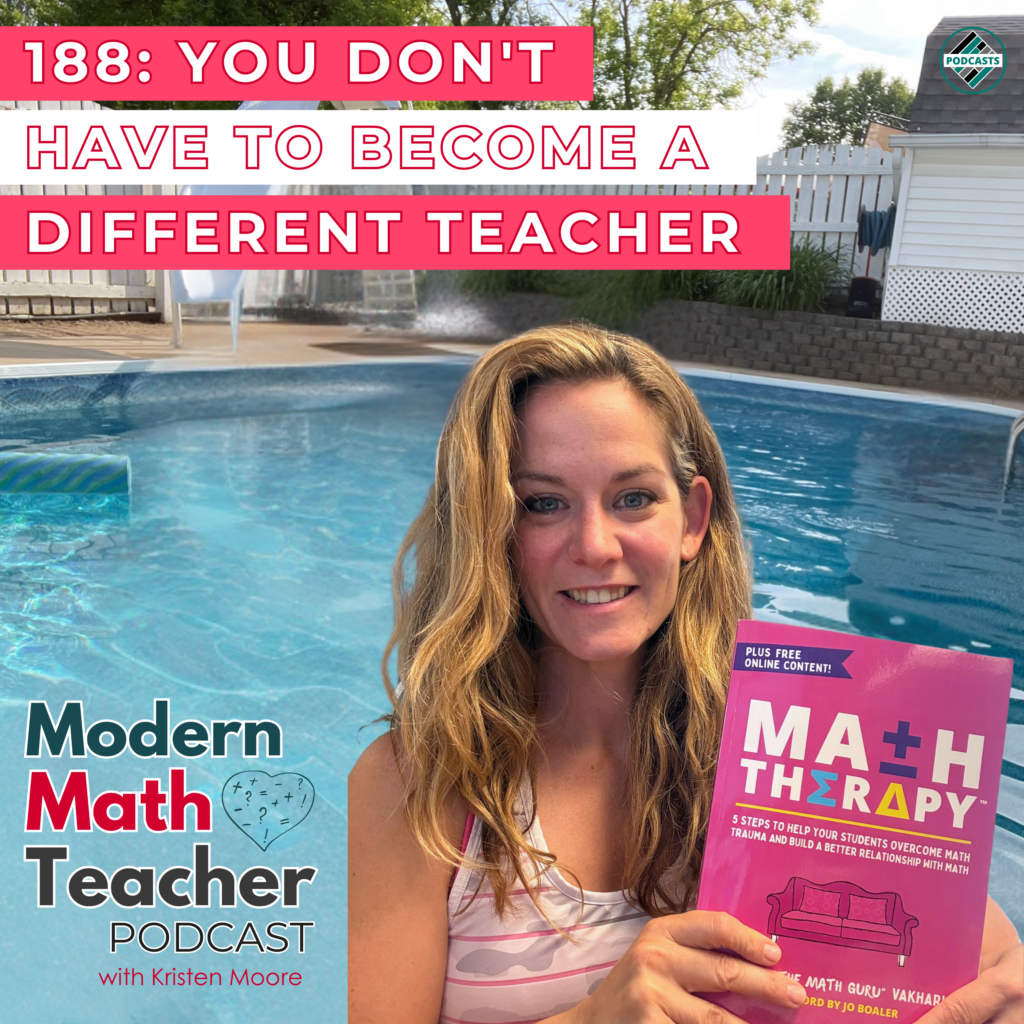
After eight weeks of reading Math Therapy by Vanessa Vakharia, we’ve reached the final chapter. And while it’s the shortest chapter in the book, it may have left me with the biggest takeaway of the entire series.
Not because it introduced another strategy, or because it gave me another classroom activity.
But because it reminded me why we pursue professional learning in the first place.
We don’t read books like Math Therapy because we think we’ve already figured everything out.
We read because we believe our students deserve the very best version of us.
That doesn’t mean becoming a completely different teacher.
It means becoming a more intentional one.
Growth Happens One Step at a Time
One of my favorite reminders from this final chapter is that helping students build healthier relationships with mathematics isn’t something we accomplish in a single lesson or even a single school year.
It’s a journey.
We don’t eliminate math anxiety after one conversation.
Students don’t suddenly develop confidence because we introduced one new routine.
Identity doesn’t change overnight.
Instead, change happens through hundreds of small moments.
- One encouraging conversation.
- One productive struggle.
- One reflection.
- One favorite mistake.
- One goal.
- One success.
Those moments may feel small on their own, but together they reshape how students see themselves as learners.
That’s true for our students.
And it’s true for us as teachers, too.
Your Version of Math Therapy Shouldn’t Look Like Mine
One idea I appreciated throughout Math Therapy is that Vanessa never asks teachers to copy her classroom.
Instead, she invites us to reflect on our own.
As I worked through each chapter, I realized I wasn’t trying to recreate Vanessa’s teaching.
I was designing something that fit my students, my classroom, and my teaching philosophy.
For my Geometry Proficiency Lab, that now includes:
- Math autobiographies
- Math Story Makeovers
- Math-o-GRAPHy
- Monday goal setting
- Thursday reflection journals
- Progress trackers
- SMART goals
- Favorite Mistakes
- Classroom agreements
- Student reflection routines
None of those ideas existed in exactly this way before I started reading this book.
Not because Vanessa handed me a blueprint, but because she inspired me to build one.
That’s what great professional learning should do.
It shouldn’t produce identical classrooms.
It should help each of us become more thoughtful versions of ourselves.
Authentic Teaching Is Better Than Perfect Teaching
Throughout this series, one theme kept resurfacing.
The best classrooms reflect the teacher leading them.
Some teachers naturally connect through journaling.
Others thrive with discussion.
Some build incredible classroom communities through mindfulness.
Others excel at feedback, routines, or relationship-building.
None of those approaches are more “correct” than another.
They’re simply different.
The goal isn’t to adopt every strategy we encounter.
The goal is to identify the practices that align with who we are and intentionally strengthen those.
When teaching feels authentic, students notice.
They trust it.
And that authenticity becomes part of the classroom culture we’re trying to create.
“Let Them”
As I read this final chapter, I couldn’t stop thinking about another idea that’s been resonating with me lately: Mel Robbins’ simple phrase, “Let them.”
There will always be people who question the way you teach.
Some will think journaling takes too much time.
Others won’t understand reassessment.
Some may believe relationship-building isn’t rigorous enough.
Let them.
They’re teaching their students.
You’re teaching yours.
Our responsibility isn’t convincing everyone else that our classroom is right.
Our responsibility is creating the learning environment our own students need.
If reflection helps your students grow, keep reflecting.
If classroom agreements build belonging, keep using them.
If Favorite Mistakes help students see errors differently, keep celebrating them.
Teach in a way that’s consistent with your values and your students’ needs.
Looking Back at the Journey
When I started reading Math Therapy this summer, I thought I might leave with one or two new classroom ideas.
Instead, I found myself rethinking entire systems.
At the beginning of the summer, I simply wanted to add a math journal.
Now I’m planning an entire year centered around reflection, identity, goal setting, progress tracking, classroom agreements, and helping students collect evidence of their own growth.
That transformation didn’t happen because of one powerful chapter.
It happened one chapter at a time.
One reflection at a time.
One idea at a time.
Isn’t that exactly what we hope happens for our students?
Learning rarely happens all at once.
Growth is cumulative.
The Biggest Lesson I’m Taking Into This School Year
If I had to summarize everything I’ve learned from Math Therapy in one sentence, it would be this:
Helping students build a better relationship with mathematics begins by helping them build a better relationship with themselves.
When students believe they belong, they’re more willing to participate.
When they recognize their own growth, they’re more willing to persevere.
When they rewrite the stories they’ve believed about themselves, new possibilities begin to emerge.
That’s bigger than mathematics.
That’s identity.
And identity shapes everything.
Reflection Questions
As you prepare for a new school year, spend a few minutes reflecting on these questions:
- What’s one idea from this book study you’re excited to implement?
- How has your own thinking changed throughout these eight chapters?
- What kind of mathematical identity do you hope your students develop this year?
- What would becoming a more intentional teacher look like in your own classroom?
You don’t have to overhaul everything.
You don’t have to implement every strategy.
Choose one meaningful change.
Implement it well.
Then continue growing alongside your students.
Because meaningful transformation—for teachers and students alike—happens one intentional step at a time.
Read Along With Us
📖 Physical Book: https://amzn.to/42VJRl6
🎧 Audiobook: https://amzn.to/49nV55D
Even though we’ve reached the end of the book study, it’s never too late to read Math Therapy and reflect on how these ideas can strengthen your own classroom.
Next Week’s Special Episode
I’m thrilled to welcome Vanessa Vakharia to the podcast! We’ll reflect on the book together, discuss the ideas that challenged me the most, answer listener questions, and explore how teachers can continue building classrooms where students develop healthier relationships with mathematics.
 Listen & Connect
 Listen to the episode: https://www.buzzsprout.com/2187419/episodes/19430527
 Instagram: @moorethanjustx
 Join the free FB group: The Modern Math Teacher Community
 Become a Modern Math Teacher Member
 Explore more resources: www.moorethanjustx.com