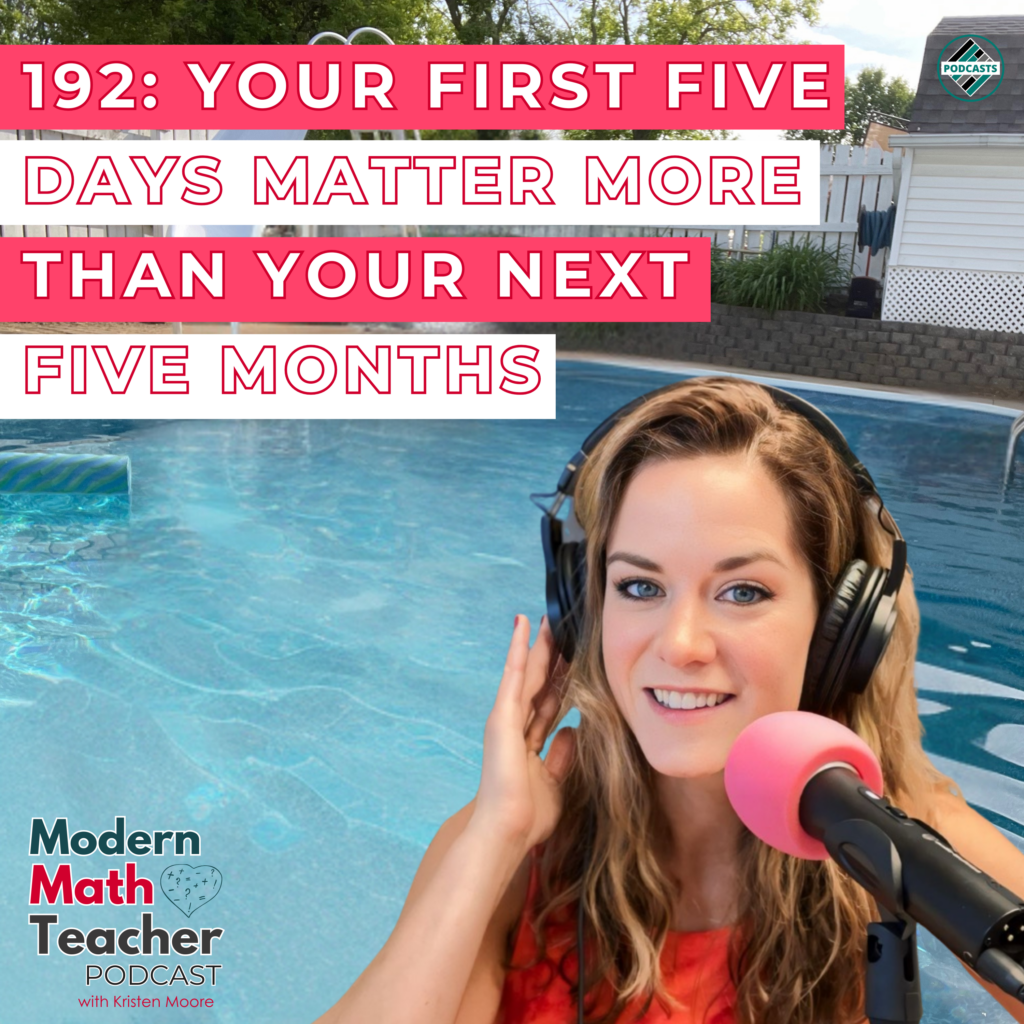
Why the most important lesson you teach all year probably isn’t math.
If you’re getting ready for a new school year, you probably have a pretty long list of things to figure out.
You need to plan the first week, teach routines, explain expectations, introduce your grading system, organize your classroom, and somehow make sure students are ready to start learning the actual curriculum.
For a long time, that’s how I thought about the first week of school, too.
I saw those first few days as a time to get organized and establish the systems that would make the rest of the year run smoothly.
And those things matter.
But over the years, I’ve started thinking about the first week very differently.
Because what if the most important thing you’re teaching during those first five days isn’t a mathematical standard at all?
What if you’re teaching students what it feels like to be a mathematician in your classroom?
Before students solve their first equation, they’re already learning.
They’re learning whether mistakes are safe. Whether their ideas matter. Whether questions are welcomed. Whether speed matters more than understanding. Whether mathematics is something they can figure out or something they’re either “good at” or not.
And we’re teaching them all of that, whether we realize it or not.
Students Don’t Walk Into Our Classrooms as Blank Slates
I’ve taught in a lot of different environments over the years. I’ve worked with project-based learners, intervention students, honors students, students who genuinely love mathematics, and students who walked into my classroom already convinced they were terrible at it.
One thing I’ve realized is that none of those students arrive as blank slates.
They walk into our classrooms carrying stories.
Some of those stories were written by previous teachers. Some were written by parents, report cards, classmates, or social media. And some of them have been reinforced for years.
“I’ve never been good at math.”
“I’m just not a math person.”
“I barely passed last year.”
“This is my honors class. I better not mess up.”
“I’m only in intervention because I’m bad at math.”
The interesting part is that none of those students have solved a single problem in my classroom yet.
And they’ve already decided something about who they are.
That’s one of the biggest reasons I’ve changed how I think about the first week of school. I’m not just introducing students to my classroom. I’m giving them an opportunity to experience mathematics differently.
I’m giving them new evidence about themselves.
The First Week Teaches More Than Procedures
For a long time, I thought the first week was mostly about getting organized.
Go over the syllabus. Explain the grading system. Assign seats. Practice routines. Collect supplies. Make sure everyone knows what to do when they walk through the door.
And I still believe those things matter. Students need structure. They need to know what we expect from them and how our classroom works.
But those aren’t the only lessons happening during the first week.
Every interaction is communicating something about mathematics.
When a student gives an incorrect answer, we’re teaching something.
When a student says, “I don’t understand,” our response teaches something.
When someone shares a strategy that’s completely different from everyone else’s, the way we respond teaches something.
When a student changes their mind after hearing another person’s reasoning, we have an opportunity to teach something about what it means to learn.
Long before students remember the first standard we covered, they’re going to remember how they felt in the classroom.
Did they feel safe enough to share an idea?
Did mistakes feel embarrassing or expected?
Did they feel like their thinking mattered?
Did they leave class thinking, “Maybe I can actually do this?”
Those are instructional design questions, too.
From Planning Lessons to Designing Experiences
One of the biggest shifts in my own teaching has been moving from simply planning lessons to intentionally designing experiences.
When I’m planning the first few days of school now, I still think about routines. How will students transition between activities? How will they work in groups? How will they ask for help? How will assessments work?
But I’m also asking myself a completely different set of questions.
What experiences will help students realize mistakes are part of learning?
What opportunities will show them that every voice matters?
How can I create moments where students experience success early, not because the mathematics is easy, but because they’re supported?
How do I communicate that mathematics isn’t something we race through, but something we make sense of together?
Those questions change what I put on the calendar.
Instead of asking only, “What do I need to teach?” I’m also asking, “What do I want students to experience?”
That’s a very different way to plan.
What Does It Mean to Learn Mathematics Together?
One of the first things I want students to help create this year isn’t a list of classroom rules.
It’s a conversation about what it means to learn mathematics together.
What does respectful disagreement sound like? How should we respond when someone makes a mistake? What does it look like to ask a good mathematical question? What responsibilities do we have to each other when we’re working as a team?
Those conversations become our classroom norms.
Not because I want a pretty poster hanging on the wall.
Because eventually, someone will give an incorrect answer. Someone will be frustrated. Someone will be ready to give up.
And when those moments happen, I don’t want to invent our classroom culture on the spot. I want to be able to remind students, “Remember what we decided together?”
That’s why the first week matters.
You’re building something you’ll rely on for the next 175 school days.
Students Are Asking, “Do I Belong Here?”
There’s another question students are constantly asking themselves, whether they say it out loud or not:
Do I belong here?
- Do I belong in honors?
- Do I belong in Algebra?
- Do I belong in intervention?
- Do I belong in STEM?
- Do I belong in an advanced class?
That’s a pretty heavy question for a fourteen-year-old to carry.
And sometimes our students have already answered it before they ever meet us.
That’s why I don’t think our job during those first few days is to convince students they’re “good at math.” Our job is to give them evidence that they belong in mathematical conversations.
Maybe that means celebrating a creative strategy instead of only celebrating the correct answer.
Maybe it’s asking a student to explain their thinking because they noticed something no one else did.
Maybe it’s allowing students to revise an idea instead of treating a mistake like a dead end.
Those moments can seem small, but they’re evidence.
And students collect that evidence.
Over time, it becomes part of the story they tell themselves about who they are as mathematicians.
So What Should You Actually Plan?
If you’re sitting down to plan your first week, I’m not going to give you a list of ten activities you need to squeeze into your calendar.
That’s actually the opposite of what I’m suggesting.
Instead, take the plans you already have and look at them through your students’ eyes.
Pretend you’re walking into your classroom for the first time. Move through each day as if you were one of your students, and ask yourself:
What is this experience teaching me about mathematics?
- Does it teach me that mistakes are expected?
- Does it teach me that my thinking matters?
- Does it teach me that curiosity is valued?
- Does it teach me that mathematics is about understanding rather than speed?
- Does it teach me that I belong here?
You may not need to completely redesign your first week. You may just need to become more intentional about the experiences you’re already creating.
The Question I’m Asking Myself This Year
As I get ready for another school year, there’s one question I’ve written at the top of my planning notebook.
It’s not, “How do I get through Unit 1?”
It’s not, “How do I stay on pace?”
It’s not even, “How do I improve test scores?”
Those things matter. Of course they do.
But the question I’m asking myself is:
How do I want students to feel when they walk out of my classroom after the first week?
If they leave thinking, “Maybe I can do this,” I’ve accomplished something important.
If they leave feeling safe enough to ask questions, I’ve accomplished something important.
If they leave realizing that mathematics is about thinking, not perfection, I’ve accomplished something important.
The standards will come. The content will come. The assessments will come.
But those beliefs?
Those begin forming on Day One.
Your First Week Is an Opportunity
So as you prepare for back-to-school, don’t just ask yourself what you need to teach during those first five days.
Ask yourself what you want students to learn about themselves.
- About mathematics.
- About your classroom.
- About what it means to struggle.
- About what it means to contribute.
- About what it means to belong.
Because the first week isn’t just the beginning of your curriculum. It’s the beginning of the story students are going to tell themselves about what it means to be a mathematician in your classroom.
And that story may shape the next five months far more than any lesson you’ll teach.
One Question to Take With You
Before you finalize your first-week plans, ask yourself:
At the end of your first five days, what story do you want your students to believe about themselves as mathematicians?
Start there.
Then design backward.
And if you’re looking for a framework to help you intentionally design meaningful learning experiences throughout the year, check out my Gold Standard Project Planner. It helps you start with what you want students to understand, experience, and create before you ever decide what the activity should be.
Download the Gold Standard Project Planner
 Listen & Connect
 Listen to the episode: https://www.buzzsprout.com/2187419/episodes/19602943
 Instagram: @moorethanjustx
 Join the free FB group: The Modern Math Teacher Community
 Become a Modern Math Teacher Member
 Explore more resources: www.moorethanjustx.com