I used to think lesson planning was pretty straightforward.
Figure out what students needed to learn. Find an activity. Gather the materials. Make the slides. Plan the questions. Print whatever needed to be printed.
Then teach the lesson.
And honestly, that worked.
At least, it worked well enough that I didn’t question the process for a long time.
But over the years, I’ve started to realize that there is a pretty significant difference between planning a lesson and designing a learning experience.
That distinction has changed the way I think about almost everything I do in my classroom.
The Activity Isn’t the Point
Think about the way we often talk about lesson planning.
What’s the activity?
What should students do?
What worksheet should I use?
What technology could make this more engaging?
Those are reasonable questions. But they’re questions about the vehicle rather than the destination.
The more I reflected on my own teaching, the more I realized that some of the lessons students remembered most weren’t necessarily the ones with the most impressive activities.
They remembered the moment they finally understood something.
The problem they couldn’t stop talking about.
The discussion where someone completely changed their mind.
The time they solved something they were convinced they couldn’t solve.
The unexpected connection.
The moment when a difficult idea suddenly made sense.
They remembered the experience.
Not the worksheet.
That realization made me start asking a different question when I planned:
What do I want my students to experience?
Start With the Mathematics
This doesn’t mean ignoring the standards or throwing out your curriculum.
In fact, I still start with the mathematics.
What do students need to understand?
What mathematical ideas are most important?
What misconceptions might get in the way?
What does meaningful understanding actually look like?
But instead of immediately moving from the learning goal to an activity, I add another step.
What do I want students to experience while they’re learning this?
Maybe I want them to experience productive struggle.
Maybe I want them to notice a pattern before I explain it.
Maybe I want them to compare two different strategies and decide which makes more sense.
Maybe I want them to realize that there isn’t always one obvious way to approach a problem.
Maybe I want them to make a prediction and then test it.
Maybe I want them to leave the classroom feeling like they understand something they didn’t understand when they walked in.
Once I know that, the activities become much easier to choose.
I’m no longer asking, “What’s something fun I could do with this standard?”
I’m asking, “What would actually create the experience I’m trying to design?”
That’s a very different planning process.
Learning Experiences Don’t Have to Be Big
I think this is where the idea can sometimes feel more complicated than it needs to be.
When we hear phrases like learning experience or student-centered learning, it’s easy to picture elaborate projects, weeks of planning, or some perfectly designed classroom activity.
That’s not what I’m talking about.
A meaningful learning experience might take ten minutes.
It could be a Notice and Wonder.
A carefully chosen warm-up.
Two student solutions placed side by side with a simple question: Which approach makes more sense to you, and why?
A prediction before students calculate.
A common mistake that students have to analyze.
A conversation where students defend their reasoning instead of waiting for the teacher to confirm the answer.
The experience doesn’t have to be elaborate.
It just has to be intentional.
The Questions Change
One of the biggest things I’ve noticed is that when I start planning around the student experience, the questions I ask myself change.
Instead of asking, How can I explain this better? I might ask, What could students figure out without me explaining it first?
Instead of asking, How many problems should students complete? I might ask, What will show me that they actually understand the idea?
Instead of asking, How quickly can I get through this lesson? I might ask, Where would slowing down create a better opportunity for thinking?
Instead of asking, What activity would make this more engaging? I might ask, What would make this mathematics worth engaging with?
Those questions don’t require a completely different curriculum.
They require a different lens.
And that’s what instructional design really means to me.
The Mathematics Doesn’t Have to Change
One of my favorite things about this mindset is that it doesn’t require me to reinvent the mathematics every time I plan.
Take something as simple as solving systems of equations.
The standard doesn’t change.
The mathematical goal doesn’t change.
The curriculum doesn’t necessarily need to change.
But the experience can.
I could plan a lesson where students simply follow a set of steps and complete twenty problems.
Or I could intentionally create an opportunity for students to compare graphical, tabular, and algebraic representations. I could ask them to explain how those representations tell the same mathematical story. I could give them two different solution strategies and ask them to analyze the reasoning behind each one.
Same mathematics.
Very different experience.
That’s the part of lesson planning I find most interesting now.
I’m not necessarily trying to make lessons bigger.
I’m trying to make the decisions behind them more intentional.
Think About What Students Will Remember
If you think back to your own time as a student, chances are you don’t remember very many individual worksheets.
You probably don’t remember the exact activity your teacher used on a random Tuesday in October.
But you probably remember moments.
The teacher who made you feel capable.
The problem that seemed impossible until it suddenly wasn’t.
The project that everyone talked about.
The discussion that changed your perspective.
The class where you laughed.
The moment when you realized, Wait. I actually understand this.
Those are the experiences that stick.
And that’s why I don’t want my goal as a teacher to simply be getting through the content.
I want to think about what students are actually experiencing as they move through that content.
- Are they making sense of mathematics?
- Are they making decisions?
- Are they explaining their thinking?
- Are they noticing connections?
- Are they experiencing productive struggle?
- Are they beginning to see themselves as capable mathematicians?
Those questions matter just as much as whether I made it through the slides.
This Doesn’t Mean Every Lesson Has to Be Amazing
There’s another important piece of this mindset.
Designing learning experiences doesn’t mean every lesson needs to be memorable.
That would defeat the entire point.
I’m not trying to create a classroom where every Tuesday requires a three-hour planning session and every lesson needs to become an event.
Sometimes students need practice.
They need direct instruction or repetition.
Sometimes the most intentional choice is a simple task that gives students the opportunity to build fluency.
The goal isn’t to make every lesson extraordinary.
The goal is to make the instructional decisions intentional.
That’s a much more sustainable goal.
Start Asking a Different Question
If there’s one thing I hope teachers take away from this idea, it’s this:
Before you plan tomorrow’s lesson, pause before you start searching for an activity.
Ask yourself:
What experience do I want my students to have?
- Do you want them to notice something?
- Wonder about something?
- Struggle with an idea?
- Make a connection?
- Defend their reasoning?
- Collaborate?
- Feel successful?
- Change their mind?
That answer can guide everything that comes next.
The questions you ask, tasks you choose, the amount of time you give students.
The moments when you step in, moments when you intentionally step back, and the way students interact with one another.
Suddenly, lesson planning becomes less about collecting activities and more about designing experiences with a purpose.
From Lesson Planner to Learning Designer
I don’t think I’ll ever stop planning lessons.
There are still standards to teach, curriculum to navigate, assessments to prepare for, and activities to organize.
But I no longer want those things to be the starting point.
I want to start with the mathematics and the students.
Then I want to think intentionally about the experience that connects the two.
Because students won’t remember every lesson we teach.
They don’t need to.
But they will remember the experiences that changed how they thought about mathematics.
And sometimes, they’ll remember the experiences that changed how they thought about themselves.
That’s worth designing for.
Want to Plan More Intentionally?
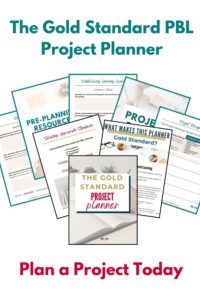
If you want to start putting this mindset into practice, I’ve created a free Gold Standard Project Planner.
Despite the name, it’s not just for projects. It’s a planning framework designed to help you start with purpose, clarify what students need to understand and experience, and then intentionally build the learning experience around those goals.
Whether you’re planning a ten-minute task, a full lesson, or a larger learning experience, the same idea applies:
Start with the experience. Then choose the activity.
You can download the free planner here:
Download the Gold Standard Project Planner
One Question to Take With You
The next time you sit down to plan a math lesson, don’t start by asking:
“What activity should I do?”
Start here:
“What do I want my students to experience?”
That one question might change more about your lesson than adding another activity ever could.
 Listen & Connect
 Listen to the episode: https://www.buzzsprout.com/2187419/episodes/19625228
 Instagram: @moorethanjustx
 Join the free FB group: The Modern Math Teacher Community
 Become a Modern Math Teacher Member
 Explore more resources: www.moorethanjustx.com