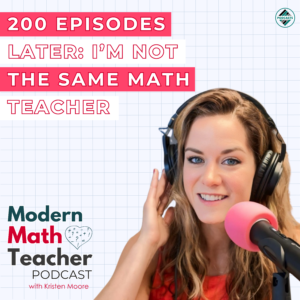
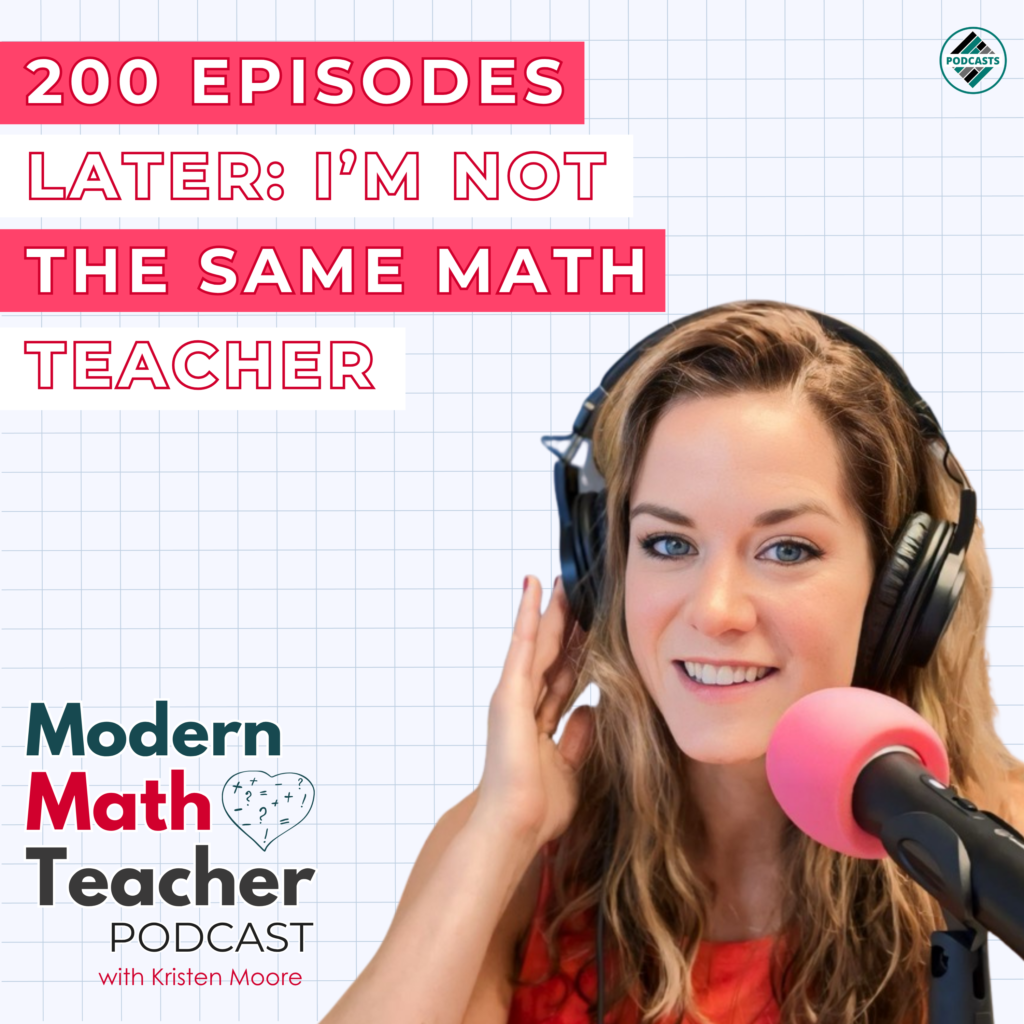
Two hundred episodes.
Honestly, I’m not entirely sure what you’re supposed to do for a 200th podcast episode. Make a list of 200 things I’ve learned? Absolutely not. We would be here until next school year.
Instead, I wanted to take a moment to reflect.
Because when I think about the teacher who started The Modern Math Teacher Podcast compared to the teacher sitting here recording Episode 200, I know one thing for sure:
I’m not the same math teacher.
And I think that’s a really good thing.
This podcast has become a place where I share what’s happening in my classroom, what I’m trying, what’s working, what’s not working, and the conversations that are changing the way I think about teaching. It has also become a record of my own professional growth.
When I look back over the last 200 episodes, I can see how much my teaching has evolved. My instructional practices have changed. My relationship with technology has changed. My understanding of what it means to be a “modern” math teacher has changed.
But some things have stayed exactly the same.
I Used to Think I Needed to Find “My Way” to Teach
Earlier in my career, I think I was always trying to figure out what kind of teacher I was.
Maybe you know what I mean.
“I’m a project-based learning teacher.”
“I use Modern Classrooms.”
“I’m a Building Thinking Classrooms teacher.”
“I’m an inquiry teacher.”
We often talk about instructional practices as though they need to become part of our identity. We find a framework that resonates with us, and then we start to believe that we need to commit to that approach in every part of our classroom.
For a long time, I would have confidently described myself as a project-based learning teacher.
And PBL still has my heart. I love watching students use mathematics for something meaningful. I love giving them problems that don’t have a predetermined path. I love seeing students create, model, make decisions, defend their thinking, and realize that mathematics is useful beyond the classroom.
But I’m not sure I would describe myself as only a PBL teacher anymore.
Not because I’ve moved away from projects.
Because I’ve moved toward so many other things, too.
Every Version of My Classroom Taught Me Something
Over the years, I’ve taught through several different instructional approaches, and each one has shaped the teacher I am today.
There was a period when I leaned heavily into the Modern Classrooms framework. Self-paced learning, mastery, and student ownership became important parts of how I thought about instruction. That experience deepened my understanding of what it means for students to take responsibility for their learning and how important mastery is in mathematics.
Then I began exploring Building Thinking Classrooms.
That changed the way I thought about collaboration, grouping, and student thinking. I became much more intentional about where students were doing their thinking, who they were thinking with, and how much I was saying compared to how much students were figuring out for themselves.
I started paying closer attention to what happened when I stopped being the keeper of all the mathematical knowledge in the room.
And now, teaching with Illustrative Mathematics is pushing my thinking in new ways again.
I’m spending more time thinking about inquiry, mathematical discourse, student strategies, and how students construct understanding together. I’m thinking about how to take what students are already noticing and use that thinking to move the mathematics forward.
And honestly, I’m loving being a learner again.
That might be one of the most valuable parts of teaching for me now. I don’t want to reach a point where I think I’ve figured it all out.
I Didn’t Throw Anything Away
For a long time, I think I assumed that adopting a new approach meant moving away from the old one.
If I started using Building Thinking Classrooms, did that mean PBL wasn’t the right fit anymore?
If I started teaching with Illustrative Mathematics, did that mean everything I learned from Modern Classrooms was outdated?
I don’t think that way anymore.
I’m collecting.
I’m building an instructional toolbox from the classrooms I’ve taught in, the books I’ve read, the teachers I’ve learned from, the guests I’ve interviewed, and the things I’ve tried.
That includes the things that worked beautifully and the things that completely bombed.
All of it has taught me something.
Now, instead of asking, “What kind of teacher am I?” I’m more likely to ask:
“What do these students need from me right now?”
Maybe they need inquiry.
Maybe they need direct instruction.
Maybe they need a thinking task, practice, a project, or a really rich discussion.
Maybe they need something I haven’t learned yet.
I don’t feel the same pressure to find the way to teach math.
I want to keep learning more ways to teach math well.
My Relationship With EdTech Has Changed, Too
Technology is another area where my thinking has evolved quite a bit.
I have always loved technology. Give me a new tool and I want to know what it does, what we can create with it, and how it might fit into a math classroom.
When AI became part of the education conversation, I was immediately interested. I wanted to experiment, learn, share ideas, and think about what it could make possible for teachers and students.
But the more technology I’ve used, the more discerning I’ve become.
I’m not anti-technology. Not even close.
I’m just more intentional about the role it plays.
There was a time when I might find a new tool and immediately ask:
“How can I use this with students?”
It was new. It was exciting. It made class feel different.
And sometimes, different was enough for me to call something innovative.
Now, my first questions are much more likely to be:
- What problem is this actually solving?
- Does it help students understand the mathematics more deeply?
- Does it give me information about student thinking that I wouldn’t otherwise have?
- Does it remove a barrier?
- Does it create an opportunity that wasn’t possible without it?
- Does it help me make an instructional practice more sustainable?
Sometimes the answer is yes.
Other times the answer is no.
Sometimes paper is better. Sometimes a whiteboard is better. Sometimes the most powerful technology in the room is another student who asks, “Wait, how did you get that?”
And I don’t think choosing not to use technology makes a classroom any less modern.
Actually, I think being willing to make that choice makes me a more modern teacher.
Because modern teaching isn’t about using the newest tool.
It’s about making intentional decisions about the tools.
AI Has Changed the Conversation Again
Of course, I can’t talk about my relationship with educational technology without talking about AI.
I’ve taught teachers how to use it. I’ve experimented with it. I’ve used it in my own planning. I’ve thought a lot about what it might mean for math classrooms.
And my thinking there continues to change.
I’m increasingly less interested in asking:
“How can I get students using AI?”
And more interested in asking:
“How can AI help me create the kind of classroom I want my students learning in?”
Can it help me differentiate something faster?
Help me brainstorm a more relevant context?
Or help me create supports so more students can access a rich task?
Can it take something off my plate so that an instructional practice I value is actually sustainable?
That’s where AI gets really interesting to me.
I don’t want technology replacing the best parts of learning mathematics. I don’t want it replacing struggle, discussion, curiosity, collaboration, or the moments when students make sense of something together.
I want more of those moments.
So if technology can give me back the time and capacity to create more of them, I’m interested.
That’s a very different mindset than using technology simply because it’s available.
Maybe This Is What “Modern” Really Means
When I started this podcast, I probably associated the word modern much more heavily with innovation, new practices, new technology, and doing things differently than we had always done them.
Two hundred episodes later, I think my definition has changed.
Being modern isn’t about constantly adding something new.
It’s about being willing to question what you’re already doing.
It’s being curious enough to try something, reflective enough to notice whether it worked, and confident enough to change your mind when it didn’t.
Sometimes innovation means adding something.
Or it means taking something away.
Sometimes it means using a new AI tool.
Or it means putting students at a whiteboard with a good problem and getting out of their way.
The tool isn’t what makes the teaching modern.
The intentionality is.
Some Things Haven’t Changed
For all of the things that have changed about my teaching, there are some things that haven’t.
I still want my students experiencing mathematics that is real.
I want them to see that the mathematics we learn in class exists outside of math class.
I still want it to be relevant.
Not just technically real-world, but connected to students’ lives, interests, communities, and the world around them in ways that give the mathematics meaning.
And I absolutely still want it to be rigorous.
I want students thinking, reasoning, questioning, modeling, defending, making mistakes, changing their minds, and figuring things out.
Real.
Relevant.
Rigorous.
That part hasn’t changed.
How I get us there?
That has changed a lot.
And I hope it keeps changing.
PBL Still Has My Heart
So where does project-based learning fit into all of this?
It’s still here.
It isn’t going anywhere.
PBL has my heart because there is something incredibly powerful about watching students take mathematics out of the little box we’ve put it in and actually use it.
To create something, solve something, make a decision, and answer a question that doesn’t already have a predetermined path.
I still want those experiences for my students.
But I don’t need every day to look like a project anymore.
I can see the value in an inquiry lesson that gets students curious before they know the rule. I can see the value in a Building Thinking Classrooms task that gets everyone standing up, talking, and thinking. I can see the value in explicit instruction when students need clarity and practice when they need fluency.
I can see the value in a rich mathematical discussion where students don’t produce anything at the end except a better understanding of an idea.
And then, when the right mathematics comes along, I can still say:
“Ohhhh, this needs a project.”
I’m not trying to prove that one teaching practice is better than all the others anymore.
I’m trying to become better at knowing which practice my students need and when.
That’s one of the biggest ways I’ve changed.
What 200 Episodes Have Actually Taught Me
If you were hoping Episode 200 would finally reveal the secret to teaching math, I’m sorry to disappoint you.
I don’t have it.
Actually, I think 200 episodes have convinced me there probably isn’t one.
I’ve interviewed incredible educators who approach teaching very differently. I’ve read books that challenged things I believed. I’ve tried practices that completely changed my classroom and other practices that sounded amazing but absolutely did not work for me.
I’ve changed schools.
Changed curricula.
Changed students.
Changed my mind.
And every time I think, “Okay, now I know what kind of teacher I am,” I learn something else.
And I love that.
I don’t want to reach the point where I think I’ve figured this out. My students are going to keep changing. Our world is going to keep changing. The tools are going to keep changing.
Hopefully, I’m going to keep changing, too.
Because I don’t think professional growth is about collecting enough strategies until you finally become a great teacher.
I think it’s about staying curious.
Thank You for Being Here
I can’t finish Episode 200 without saying thank you.
There are approximately eleven billion podcasts you could listen to, and somehow, you keep choosing this one.
Some of you have been here for a really long time. Some of you found me last week. Some of you listen on your commute, while you’re getting ready for school, or while you’re grading.
Some of you send me messages about something I said in an episode that made you think differently.
And some of you have shared ideas with me that have made me think differently.
That’s the coolest part of all of this.
This podcast started as a place for me to share what I was learning in my classroom.
Two hundred episodes later, it still is.
The difference is that now I get to learn alongside all of you.
And I don’t take that for granted.
Let’s Keep Learning Together
I don’t have a resource to sell you today.
I don’t have a workshop I need you to go buy.
For Episode 200, I really just want to invite you to stay connected.
If you’ve been listening for 10 episodes or 200, come say hi. Reply to one of my emails. Find me online. Send me a message.
Tell me:
What’s something you’ve changed your mind about as a math teacher?
What did you used to swear by that you don’t anymore?
What teaching practice surprised you?
What are you experimenting with right now?
What’s changing in your classroom?
Those are the conversations I want to keep having for the next 200 episodes.
And before you go, here’s your question to think about this week:
If the teacher you were five years ago walked into your classroom today, what would surprise them most?
And maybe even more importantly:
What do you hope will surprise today’s version of you five years from now?
I hope we keep changing, questioning, trying things, and learning from each other.
And I hope, through all of it, we keep finding better ways to give our students opportunities to experience mathematics that is real, relevant, and rigorous.
Thank you for being here.
Thank you for listening.
Thank you for learning alongside me for 200 episodes.
Here’s to whatever we learn in the next 200.
Until next time, keep it real.
 Listen & Connect
 Listen to the episode: https://www.buzzsprout.com/2187419/episodes/19805098
 Instagram: @moorethanjustx
 Join the free FB group: The Modern Math Teacher Community
 Become a Modern Math Teacher Member
 Explore more resources: www.moorethanjustx.com