Have you ever looked at a lesson in your curriculum and thought, My students are never going to connect with this.
Or maybe you’ve found yourself thinking:
If I had a better curriculum, I could teach the way I actually want to teach.
I’ve been there.
Most of us don’t get to choose every resource we use in our classrooms. We inherit curriculum from a district. We work within pacing guides. We teach standards that someone else has sequenced. We use assessments we didn’t create.
And sometimes, that can feel limiting.
But over the years, I’ve realized something that completely changed the way I think about curriculum:
Your curriculum influences your teaching. It does not define your teaching.
I Don’t Always Love Every Lesson
When I first started using Illustrative Mathematics, I had mixed emotions.
There were parts I loved immediately. I appreciated the emphasis on mathematical discourse, rich tasks, and students explaining their thinking instead of simply producing answers.
But there were also lessons that made me scratch my head.
Some contexts didn’t feel particularly connected to my students. Some activities moved more slowly than I wanted. Sometimes I would look at a lesson and think, My students are going to need something different here.
Earlier in my career, I probably would have responded in one of two ways.
I would either teach the lesson exactly as written, even if I wasn’t convinced it was the best fit.
Or I would throw the whole thing out and start from scratch.
Neither is a particularly sustainable option.
One ignores your professional judgment.
The other ignores your time.
Eventually, I realized there was a third option.
I could use the curriculum without being controlled by it.
Start With the Purpose, Not Your Opinion of the Lesson
Now, when I open a lesson, I don’t start by asking:
“Do I like this lesson?”
Instead, I ask:
“What’s the purpose of this lesson?”
- What mathematical idea are students supposed to discover?
- What misconception is the activity designed to uncover?
- What conversation is this task trying to create?
- What do I actually want students to understand or be able to do by the end?
Once I understand the purpose, everything else becomes easier.
- Maybe I keep the lesson exactly as written.
- Maybe I change the context because I know my students will connect with something else.
- Maybe I shorten an activity.
- Maybe I add a quick warm-up because my students need a little more background knowledge before jumping in.
- Maybe I build in another opportunity for students to compare strategies.
Notice what I’m not doing.
I’m not rewriting the curriculum.
I’m refining the learning experience.
And those are two very different things.
The Curriculum Gives Me Structure. I Still Get to Make Decisions.
One of the things I appreciate most about teaching now is that I no longer feel like I have to choose between following the curriculum and following my professional instincts.
Those aren’t opposites.
The curriculum gives me structure. It gives me a sequence, standards, tasks, questions, and ideas. That’s incredibly valuable.
But it doesn’t know my students.
It doesn’t know that my first-hour class needs more wait time than my fifth-hour class.
It doesn’t know that one group thrives when they can immediately jump into discussion while another group benefits from seeing a quick visual example first.
It doesn’t know that one class needs an additional scaffold while another is ready for an extension question.
That’s where I come in.
That is the work only a teacher can do.
What Does Adapting Actually Look Like?
I think the word adapt can sometimes make teachers nervous.
It sounds like hours of extra planning.
It doesn’t have to be.
Most of the time, adapting a lesson looks surprisingly small.
- Maybe I change the context.
- Maybe I remove a question that isn’t moving the learning forward.
- Maybe I add a Notice and Wonder before students begin.
- Maybe I ask students to compare two strategies before moving on.
- Maybe I build in a quick reflection at the end.
Those small decisions can change the experience without requiring you to rebuild the entire lesson.
That’s intentional instructional design.
You’re taking the tools you already have and making thoughtful decisions about how students will experience them.
Ask Better Questions Before You Teach
When I open tomorrow’s lesson, I usually find myself asking a handful of questions:
- What is the mathematical goal?
- Where might students struggle?
- Where do I want them to talk?
- What misconceptions am I hoping to uncover?
- Is this context meaningful for my students?
- What can I leave exactly as it is?
- What, if anything, actually needs to change?
I love that last question.
Because earlier in my career, I assumed everything needed to change.
Now I assume very little does.
Sometimes the best instructional decision is to leave a great lesson alone.
That’s growth, too.
Two Teachers Can Teach the Same Lesson and Create Completely Different Experiences
This is one of the reasons I think teachers sometimes underestimate their own influence.
I’ve heard teachers say, “We’re just teaching the curriculum.”
But we’re never just teaching the curriculum.
Two teachers can open the exact same lesson on the exact same page and create completely different classroom experiences.
One classroom might feel rushed.
Another might feel curious.
One might become a worksheet.
Another might become a rich mathematical discussion.
The curriculum didn’t change.
The teacher did.
That’s why I don’t think our greatest value comes from creating every lesson from scratch.
Our greatest value comes from noticing what our students need and making thoughtful decisions in response.
No curriculum can do that.
Only a teacher can.
You Don’t Need the Perfect Curriculum
If you’ve ever found yourself wishing for a different curriculum, I understand.
Sometimes there are real frustrations with the materials we’re given. Sometimes a lesson genuinely needs adapting. Sometimes a resource isn’t the right fit.
But I think there’s a more useful question than “Is this curriculum good enough?”
Try asking:
“How can I help this lesson become the best version of itself for my students?”
That’s a question you can answer no matter what curriculum is sitting on your desk.
Whether you’re teaching Illustrative Mathematics, CPM, Reveal, Carnegie, Big Ideas, Eureka, or a district-created curriculum, you still have opportunities to make intentional decisions about the learning experience.
You don’t need a blank page.
You need a reason for the choices you’re making.
Curriculum Is a Tool. It Isn’t Your Identity as a Teacher.
I don’t want teachers walking away from this thinking they need to fight their curriculum.
That’s not the goal.
The goal is to stop seeing curriculum as something that determines what good teaching looks like.
Use it.
Question it.
Adapt it when necessary.
Lean on it when it works.
And trust your professional judgment when your students need something different.
Because great teaching has never been about finding the perfect curriculum.
It’s about making intentional decisions with the one you have.
A Question to Take Into Tomorrow’s Lesson
The next time you open your curriculum, pause before you start planning.
Instead of seeing a script to follow, ask yourself:
- What opportunity is here?
- What is this lesson trying to accomplish?
- What do my students need?
- Where could I make a small adjustment?
- And what can I simply leave alone?
You don’t have to reinvent the lesson.
You don’t have to throw out the curriculum.
You don’t have to start from scratch.
You just have to step into the role of the teacher who is designing the experience.
Because the curriculum may provide the map.
But you are still the guide.
Want to Be More Intentional About Lesson Design?
If you’re ready to think beyond “What activity should I do?” and start designing learning experiences around what you actually want students to understand, experience, and create, I’ve created a free resource to help.
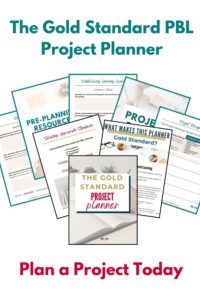
The Gold Standard Project Planner helps you identify the learning goal first and then intentionally design the experience around it, whether you’re following your curriculum closely or making thoughtful adjustments along the way.
Download the free Gold Standard Project Planner
The goal isn’t to abandon your curriculum.
It’s to learn how to use it intentionally.
 Listen & Connect
 Listen to the episode: https://www.buzzsprout.com/2187419/episodes/19625209
 Instagram: @moorethanjustx
 Join the free FB group: The Modern Math Teacher Community
 Become a Modern Math Teacher Member
 Explore more resources: www.moorethanjustx.com