There was a time when I thought being a great teacher meant constantly impressing people.
Not my principal. Not my coworkers. Honestly, mostly myself.
Every lesson needed to be bigger, better, more creative, more engaging, or more interactive than the one before it. If I saw an amazing idea on Pinterest, I wanted to try it. If another teacher shared an incredible activity, I added it to my list. If I found a cool new technology tool, obviously I needed to figure out how to use that too.
And for a while, it was exciting.
I loved experimenting. I loved watching students get excited about something I had created. I loved the feeling of walking out of a class thinking, That was really good.
The problem was that eventually, “really good” stopped being enough.
I started feeling like every lesson had to be better than the last one.
When every lesson has to be extraordinary
I don’t think burnout happened all at once for me. It happened one lesson at a time, one resource at a time, one “this would be so cool” at a time.
Before I realized it, I wasn’t just planning lessons anymore. I was producing events.
Every day felt like I needed to come up with something new that would impress my students, keep them engaged, and make the lesson memorable. And because the students enjoyed those experiences, I felt like I had to keep raising the bar.
That created a cycle that was incredibly difficult to maintain.
I’d spend three hours creating an amazing lesson. The students would love it. It would go beautifully. Then I’d get home and realize I had to do it all over again tomorrow.
That’s where the problem wasn’t really the engaging lessons themselves. The problem was the belief that every lesson had to be extraordinary.
Students don’t need extraordinary every day. They need consistency, predictability, and a classroom where they know how learning works.
And honestly, so do we.
The power of consistency
One of the biggest mindset shifts I’ve had over the last several years is realizing how powerful good routines can be.
For a long time, I thought of routines primarily as a classroom management tool. Students needed to know where to put their things, how to transition, what to do when they entered the room, and how to turn in an assignment.
Those things matter, of course.
But routines can do so much more than make a classroom run smoothly.
When students know how a mathematical discussion works, how to work through a problem with a partner, how to reflect after an assessment, or how to explain their reasoning, they don’t have to spend their mental energy figuring out the process.
They can focus on the mathematics.
And there’s another benefit to intentionally building routines that I didn’t appreciate when I was younger: every routine you establish becomes one less decision you have to make later.
That’s a pretty big deal when you’re teaching six class periods, answering emails, grading assessments, planning lessons, and trying to have a life outside of school.
The more predictable the systems become, the more mental energy I have available for the things that actually require me.
Like noticing the student who’s struggling.
Listening carefully to a student’s mathematical reasoning.
Asking a better question.
Figuring out why a particular concept isn’t clicking.
Those are the things I want my energy going toward.
Not recreating my slides for the fifteenth time.
Ask yourself a different question
I still love finding new classroom ideas. I still save things I want to try. I’m still the teacher who sees something and thinks, Oh, my students would love that.
The difference is that I don’t automatically turn every good idea into a new thing I have to add to my classroom.
Now I ask myself a different question:
Can I realistically sustain this?
Could I do this next week? Could I do it in October? Could I still do it in March when testing season hits? Could I do it with six different class periods? Could I do it when I’m tired?
If the answer is no, that doesn’t necessarily mean it’s a bad idea.
It might be an incredible lesson.
But it probably isn’t a sustainable system.
And those are two very different things.
Stop reinventing. Start refining.
One of the things I’ve noticed about the teachers I admire most is that they aren’t constantly reinventing their classrooms.
They’re refining them.
They build routines, notice what isn’t working, make adjustments, and then keep using those structures until they become second nature. They aren’t starting from scratch every Monday morning.
That’s something I’ve come to value more and more.
Imagine introducing a brand-new collaborative structure every week. Students have to spend part of their mental energy learning how the new process works, figuring out what you’re asking them to do, and adjusting to the expectations.
Now imagine using the same collaborative structure throughout the year.
By October, students know how to collaborate. By January, they’re doing it almost automatically. By April, you can focus on the quality of their mathematical thinking because the structure itself isn’t taking up their attention.
That’s the kind of system that gets better with use.
And that’s what sustainable teaching looks like.
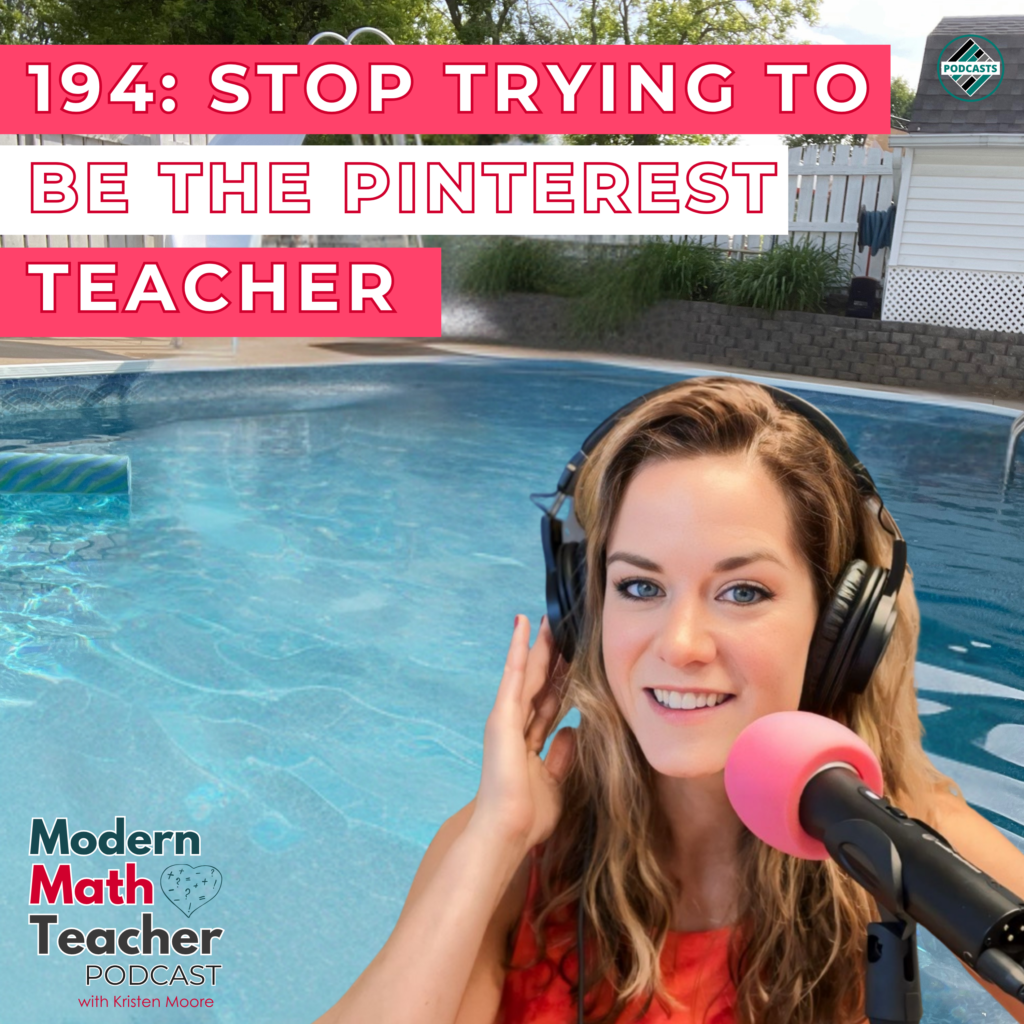
You don’t have to be the Pinterest teacher
I also want to give somebody permission to breathe.
You do not have to create a Pinterest-worthy classroom to create an unforgettable one.
Some of the best lessons I’ve ever taught weren’t beautiful. They weren’t color coordinated. They weren’t laminated. They weren’t the kinds of activities that would make someone stop scrolling on Instagram.
Sometimes they were a good problem, a whiteboard, and a conversation.
And those lessons mattered.
Students remember finally understanding something that had confused them. They remember laughing during a discussion. They remember solving something they weren’t sure they could solve. They remember the moment they realized they had a strategy that worked.
They don’t necessarily remember whether the task cards matched the bulletin board.
I think social media can make this especially difficult because we’re constantly seeing the highlight reel of teaching. Beautiful classrooms. Elaborate projects. Perfectly organized materials. Creative activities that look incredible in a carousel post.
But we’re not seeing all the time and energy that went into producing that moment.
And more importantly, your students don’t need a highlight reel.
They need a teacher who’s present. They need a teacher who is prepared. They need a teacher who still has enough energy left in April to care just as much as they did in August.
That’s the teacher I want to be.
My definition of great teaching has changed
If you had asked me ten years ago what I wanted my classroom to look like, I probably would have described the activities.
I would have talked about the projects, the technology, the engagement, and all of the exciting things I wanted students to experience.
Today, my answer is different.
I want a classroom where students know how to think together. I want them to understand how to participate in mathematical conversations, how to work productively with a partner, how to respond when they make a mistake, and how to explain their reasoning.
I want those things to become part of the culture rather than something I have to reteach every time I introduce a new activity.
And I want to spend less time managing those processes and more time listening to what students are actually thinking.
That’s what systems can do for a classroom.
They don’t replace good teaching.
They create the space for good teaching to happen.
Build something that lasts
This has changed the question I ask myself when I plan for a new school year.
Instead of asking, “What amazing lesson can I teach?” I’m much more interested in asking, “What can I build that will make the lessons that come after it better?”
Maybe it’s a discussion routine that students will use all year.
Maybe it’s a reflection process that becomes part of every assessment.
Maybe it’s a structure for collaborative problem solving.
Maybe it’s simply a classroom routine that gives students more independence and gives me back a little mental energy.
Those things aren’t necessarily exciting when you introduce them.
But they compound.
A routine you establish in August can make your classroom easier to run in October. A system you refine in October can create more independence in January. And the systems that are working by January can make the difference between feeling completely depleted in April and feeling like you still have something left to give.
That’s the kind of classroom I’m interested in building.
Not the classroom that looks the most impressive in September.
The classroom that’s still thriving in April.
Great teaching doesn’t mean doing more
I don’t think the answer to teacher burnout is simply telling teachers to care less or lower their expectations.
I think part of the answer is becoming more intentional about where we spend our time and energy.
Not every lesson needs a new activity.
Not every standard needs a project.
Not every classroom routine needs to be reinvented.
Sometimes the best instructional decision is the one that allows you to use something that already works in a more intentional way.
That’s why I keep coming back to instructional design.
Instead of asking, “What could I create?” I’m asking, “What does my goal require?”
Instead of asking, “What would be fun?” I’m asking, “What experience will best support the learning?”
And instead of asking, “How can I make this lesson more impressive?” I’m asking, “How can I make this classroom more sustainable?”
Those questions have changed the way I teach.
A more sustainable way to plan
If you’re heading into a new school year feeling like you need to create an entirely new classroom, I want you to pause before you add another thing to your planning list.
Look at what already works.
What routines could you keep?
What structures could you repeat?
What systems could become more efficient?
What decisions could you make once instead of making them six times a day?
And when you’re planning individual lessons, ask yourself what students actually need from the experience. Does the learning goal require a project? Would focused practice be more effective? Is there an existing routine you can use instead of creating something completely new?
That’s the thinking behind my Project or Practice Guide.
It isn’t about creating more work for yourself. It’s about becoming more intentional about the learning experiences you choose to create.
You can grab the free guide here:
Download the Project or Practice Guide
What are you building?
As you think about this school year, I want to leave you with a question:
Are you building a collection of memorable lessons, or are you building a classroom that can thrive all year long?
I still want to create memorable lessons.
I still want my students to be engaged. I still want to try new things and occasionally do something that makes everyone in the room say, “That was awesome.”
But I don’t want that to be the measure of whether I’m doing a good job.
I want to build something that lasts.
Because great teaching isn’t about constantly doing more.
It’s about intentionally building a classroom that works for your students and for the teacher who has to keep showing up in it.
 Listen & Connect
 Listen to the episode: https://www.buzzsprout.com/2187419/episodes/19625201
 Instagram: @moorethanjustx
 Join the free FB group: The Modern Math Teacher Community
 Become a Modern Math Teacher Member
 Explore more resources: www.moorethanjustx.com