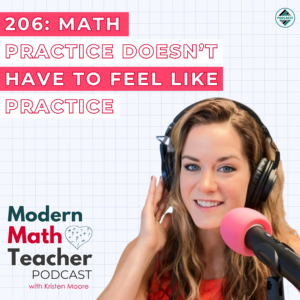
Math Practice Doesn’t Have to Feel Like Practice
Okay, I feel like I need to make an announcement.
I am pro-practice.
After talking so much about projects, real-world math, and meaningful learning experiences, I don’t want anyone walking away thinking worksheets are bad and projects are good. That’s not what I’m saying.
Students need practice. Sometimes they need to solve an equation ten times before the process starts to feel more natural. Sometimes a well-designed set of problems with immediate feedback is exactly what they need.
The question isn’t how we eliminate practice. It’s how we make intentional decisions about the practice students need and when we might be able to give that practice a purpose.
Practice Has a Job
Practice shouldn’t be busy work. It should help students develop something, whether that’s accuracy, efficiency, fluency, confidence, or the ability to apply a process independently.
Before assigning practice, I want to know:
What am I asking students to get better at?
Once I know the goal, I can choose the experience that makes the most sense. Sometimes that’s ten carefully selected problems. Sometimes it’s online practice with immediate feedback. Other times, collaboration or a larger learning experience might be a better fit.
The goal determines the approach, not the other way around.
Give Practice a Purpose
One example I love is my Stained Glass Linear Equations Project.
Students are still practicing linear equations. They’re writing and graphing equations, with options for slope-intercept form, standard form, or a combination of the two.
There’s repetition, and that’s intentional. Students need opportunities to develop fluency with the skills they’re learning.
The difference is that each graph becomes part of a stained-glass design. Instead of graphing a line, checking it, and moving on to the next problem, students see their work contribute to something larger.
The practice hasn’t disappeared. The practice has a purpose.
And that’s an important distinction. Meaningful mathematics doesn’t always require an elaborate project or an authentic adult scenario. Sometimes students find meaning in creating something, seeing patterns come together, or understanding how individual pieces contribute to a larger result.
The mathematical goal should guide the experience.
Sometimes Straightforward Practice Is Better
Now, before everybody starts turning worksheets into craft projects, please don’t! We don’t need to make every assignment more complicated.
If students need ten minutes of focused practice solving two-step equations, I probably don’t need to spend forty-five minutes setting up an elaborate activity. If immediate feedback will help them improve, an online tool might be the better choice. And if I want to see whether students can perform a skill independently, removing extra context might be exactly what I need.
Remember: Don’t increase the workload. Increase the thinking.
Sometimes we don’t even need to increase the thinking. We’re intentionally developing fluency, and that’s a worthwhile goal on its own.
The better question isn’t, “How can I make this practice more fun?”
It’s this:
Would giving this practice a purpose improve the learning experience, or would it just make things more complicated?
Sometimes the answer is yes. Sometimes it’s no. Both are okay.
Practice Can Be Part of a Bigger Learning Experience
I also don’t think projects replace practice. Some of the best projects have practice built right into them.
Students might learn a skill, practice it, apply it in a project, realize they need more support, and then return to the work with a stronger understanding.
That’s learning.
The project doesn’t eliminate the need for fluency. It can give students a reason to develop it.
This is why I want to be careful about treating teaching approaches like competing camps. Being a PBL teacher doesn’t mean abandoning worksheets. Using inquiry doesn’t mean avoiding direct instruction. Building a thinking classroom doesn’t mean students never need explicit practice.
I want all of those tools available to me.
Sometimes students need to investigate. Sometimes they need to discuss, apply, or create. And sometimes they need to practice the darn equation.
The important part is recognizing what students need right now and choosing the learning experience that supports that goal.
Look at the Practice You’re Already Assigning
Here’s something simple you can try this week. Look at one practice assignment you’re already planning to give. Don’t create anything new. Just ask yourself two questions:
What are students supposed to get better at?
Then consider whether adding a larger purpose would actually improve the experience.
Maybe the graphs could become part of a design, the calculations could help students make a decision, or the measurements could answer a question or contribute to something students are creating.
If the added context would only make the assignment more complicated, leave it alone.
But if it gives students a meaningful reason to use the mathematics, it might be worth exploring.
You don’t need to reinvent your teaching or turn every practice set into a project. You’re simply looking for opportunities to make intentional choices about how students experience the mathematics.
If Linear Equations Are Coming Up
If you’re teaching linear equations, my Stained Glass Linear Equations Project is designed to give students that experience.
Students get repeated practice writing and graphing equations while using their work to create a stained-glass design. The resource includes different practice options, answer keys, reflection pieces, and rubrics, so you can choose what fits your students’ needs without building everything from scratch.
You can find it in my Teachers Pay Teachers store if it fits what you’re teaching.
But whether you use this project or stick with your existing practice assignment, here’s the idea I want you to remember:
Practice isn’t the opposite of meaningful mathematics. Sometimes practice is exactly what meaningful mathematics requires.
We just need to be intentional about why we’re assigning it.
So, here’s your reflection for this week: What are your students practicing right now, and is there an opportunity to give that practice a purpose?
Maybe there is. Maybe there isn’t.
We’re not trying to make every assignment bigger. We’re trying to choose the learning experience that actually serves the mathematics.
Until next time, keep it real.
 Listen & Connect
 Listen to the episode: https://www.buzzsprout.com/2187419/episodes/19980041
 Instagram: @moorethanjustx
 Join the free FB group: The Modern Math Teacher Community
 Become a Modern Math Teacher Member
 Explore more resources: www.moorethanjustx.com