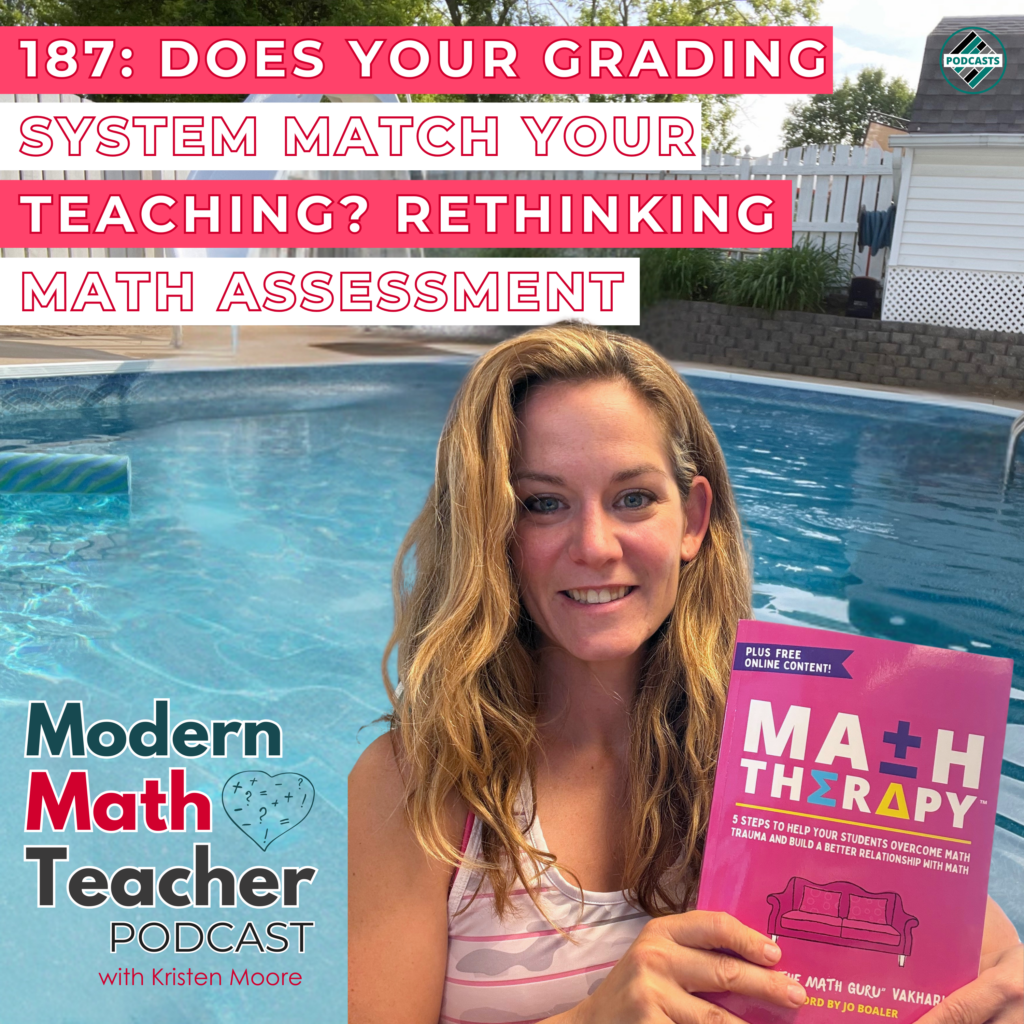
As I read Chapter 7 of Math Therapy by Vanessa Vakharia, I kept coming back to one question:
Does my grading system tell the same story as my teaching?
For years, assessment has been one of my favorite topics in education.
I began my teaching career in a competency-based school where we used proficiency scales instead of traditional percentages. Since then, I’ve spent years learning about standards-based grading, equitable grading, reassessment, and effective feedback.
So this chapter felt familiar.
It also challenged me to look beyond grades and think about the messages our assessment systems send every single day.
Because assessment isn’t just about measuring learning.
It’s about communicating what we value.
Every Grading System Tells a Story
Whether we realize it or not, every assessment practice sends students a message.
We tell students:
- Mistakes are part of learning.
- Growth matters.
- Progress is more important than perfection.
But if every early mistake permanently lowers a student’s grade, students receive a very different message.
That’s not to say there’s one perfect grading system. There isn’t.
Every school has different expectations, policies, and constraints.
Still, every teacher can ask the same question:
Does my assessment system communicate the same beliefs I talk about every day?
Assessment Should Match Its Purpose
One idea this chapter reinforced for me is that not every assessment has the same job.
In my classroom, formative and summative assessments serve different purposes.
For formative checkpoint quizzes, I prefer paper.
I want to see students’ thinking, reasoning, strategies, and their misconceptions.
Those quizzes help me understand where students are while they’re still learning.
By the time students reach a unit assessment, we use DeltaMath.
At that point, the question is different.
Can students demonstrate proficiency with the learning targets?
Those assessments aren’t competing with one another.
They’re working together.
Retakes Don’t Create Growth
One statement from this chapter immediately stood out:
The retake isn’t what creates learning.
The learning between attempts is.
That’s why students in my classroom don’t simply ask for another chance.
They prepare for it.
Before reassessing a checkpoint quiz, students complete the homework connected to that section.
Before reassessing a unit assessment, they complete corrections and the unit review.
Something should change between Attempt 1 and Attempt 2.
Otherwise, we’re simply repeating the same experience and hoping for a different outcome.
The reassessment isn’t the intervention.
It’s the opportunity to demonstrate the learning that happened in between.
Progress Over Perfection
One line from this chapter made me stop and think.
We constantly tell students:
Progress over perfection.
But does our grading system actually communicate that?
If students believe one poor performance defines them for an entire grading period, it’s hard to convince them that growth matters.
Supporting growth doesn’t mean lowering expectations.
It means recognizing that learning happens over time.
Students deserve opportunities to improve, reflect, and demonstrate what they’ve learned after additional practice.
Success Looks Different for Every Student
One idea I loved was using SMART goals that extend beyond earning an A.
Some students will absolutely set academic goals.
Others may choose something completely different.
Their goal might be:
- Ask one question every class.
- Complete every homework assignment this unit.
- Feel less anxious before quizzes.
- Use multiple strategies before asking for help.
Those goals matter.
In many cases, those habits become the foundation for stronger mathematical learning.
In my Geometry Proficiency Lab, students already begin each Monday by reflecting on the previous week and setting new goals.
This chapter encouraged me to make those conversations even more intentional.
Celebrate the Small Wins
Vanessa introduces the phrase “dopamine bites,” or small celebrations that help students recognize progress throughout the learning process.
I immediately thought about Illustrative Mathematics.
Each unit naturally breaks into smaller learning targets with checkpoint quizzes along the way. Instead of viewing those checkpoints as “just another quiz,” I want students to see them as milestones. Each one is an opportunity to pause, reflect, and recognize how much they’ve already learned.
Small wins matter.
They remind students that growth is happening, even before they’ve mastered the entire unit.
Helping Students See Their Own Growth
One implementation idea I’m especially excited about is creating a progress tracker for my intervention students.
Before each unit, students will set:
- One academic goal
- One mindset goal
Throughout the unit, they’ll record checkpoint quiz results, reflect on what helped them improve, note any reassessment they completed, and compare that progress to their unit assessment.
At the end, they’ll answer questions like:
- What am I most proud of?
- What helped me improve?
- What strategy will I use next time?
One thing I’ve noticed over the years is that students often remember the quiz they struggled on.
They forget everything that happened afterward.
Helping students document their progress gives them evidence that they are growing.
Assessment Shapes Identity
My biggest takeaway from this chapter is simple.
Our math assessment practices communicate far more than grades.
They communicate our beliefs about learning.
If we value perseverance… Students need opportunities to persevere.
If we value growth… Students need opportunities to demonstrate growth.
If we value learning… Our grading systems should communicate that learning is a process, not a single moment in time.
Reflection Questions
As you think about your own classroom, consider these questions:
- If students only experienced your grading system, what would they believe about learning?
- Do your assessments communicate progress or perfection?
- How do students recognize their own growth throughout a unit?
- What opportunities do students have to learn from mistakes before the final assessment?
Assessment is one of the most powerful messages we send students.
When our grading practices align with our beliefs about growth, students receive a much clearer message about what it truly means to learn mathematics.
Read Along With Us
 Physical Book: https://amzn.to/42VJRl6
 Audiobook: https://amzn.to/49nV55D
It’s never too late to jump into our summer book study!
 Listen & Connect
Listen to the episode: https://www.buzzsprout.com/2187419/episodes/19430521
 Instagram: @moorethanjustx
 Join the free FB group: The Modern Math Teacher Community
 Become a Modern Math Teacher Member
 Explore more resources: www.moorethanjustx.com