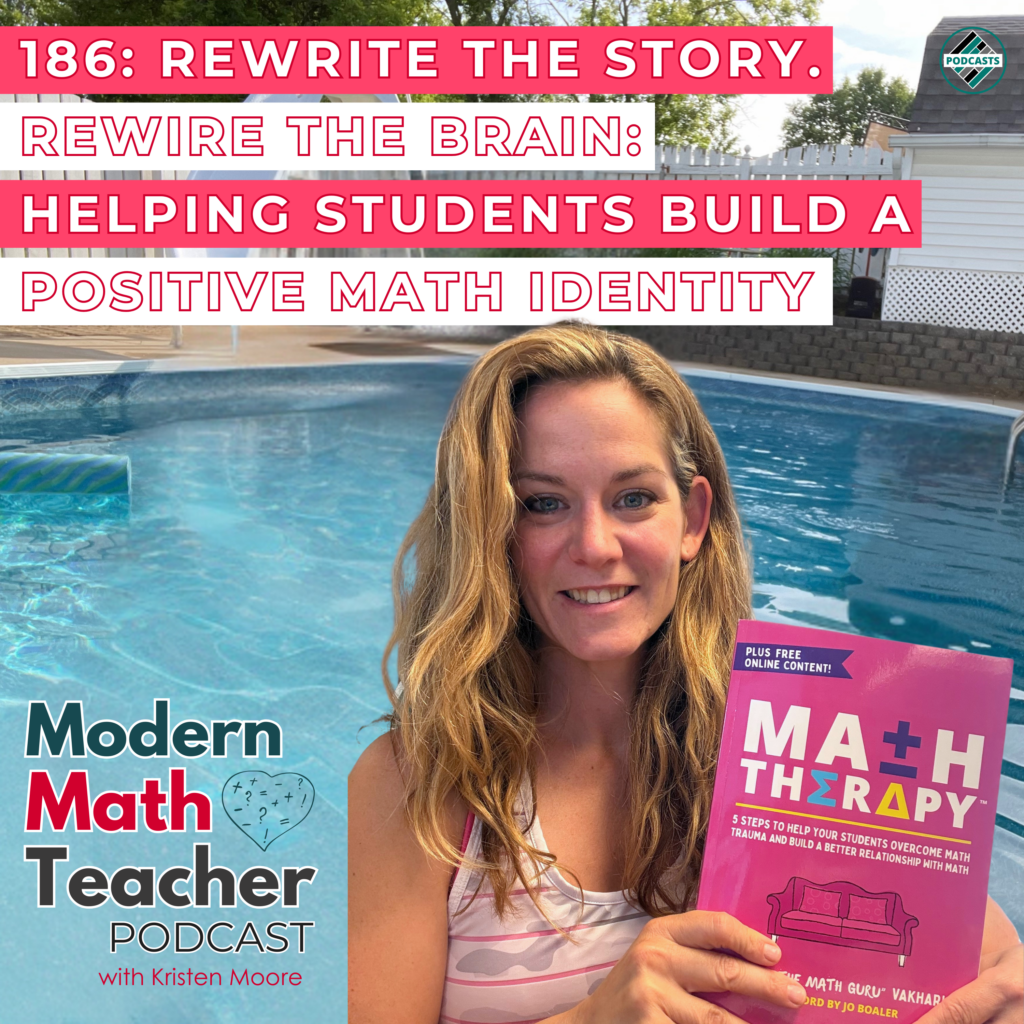
As I worked through Chapter 6 of Math Therapy by Vanessa Vakharia, one phrase stayed with me long after I closed the book:
Rewrite the story. Rewire the brain.
It perfectly captures what this chapter is about.
Improving in math isn’t only about learning new skills or getting higher test scores. It’s about changing the way students see themselves.
Every classroom experience contributes to a student’s math identity. The question is whether that identity is growing stronger or becoming more limiting.
A Math Makeover Isn’t About Math
Vanessa defines math identity as how you see yourself in the math world.
That definition stopped me in my tracks.
Notice what isn’t included.
It’s not your GPA, your standardized test score, or how quickly you solve equations.
It’s how you see yourself.
That identity influences almost everything students do.
- Do they volunteer an idea?
- Do they ask questions when they’re confused?
- Do they stick with a challenging problem?
- Do they believe they belong in a math classroom?
When students believe they’re “bad at math,” those beliefs begin shaping every decision they make. Changing that identity can change everything that follows.
My Own Math Story
This chapter challenged me to reflect on my own relationship with mathematics.
At first, I wasn’t sure I even had much of a story to tell. Math had always come fairly naturally to me. Then I realized my story wasn’t really about being “good at math.” It was about loving puzzles, challenges, and the feeling of figuring something out.
Math happened to be the place where those parts of me came alive.
In sixth grade, my teacher, Mr. Coraci, let me test out of chapters and explore math in ways we’d probably call Genius Hour today.
In seventh grade, Mr. Simon turned math into an experience. Music played while we worked, and our entire school knew the trigonometry chant from the student-versus-staff basketball game.
In eighth grade, I became a Mathlete and competed at Comerica Park.
None of those experiences simply taught me mathematics.
They taught me that I belonged there.
Then the Story Changed
That confidence took a hit during Honors Geometry.
I’ve shared this story before, but it took on new meaning after reading this chapter.
One project, one disappointing grade, one experience that made me question whether I belonged in the honors sequence.
Looking back, the issue wasn’t geometry. It was identity.
That experience changed the story I was telling myself.
Many of our students experience moments just like that.
Sometimes one assignment, one comment, or one difficult test becomes the evidence they use to define who they are as math learners.
The Moment I Became a Teacher
One of my favorite realizations while reflecting on this chapter had nothing to do with grades.
It happened in Algebra 2.
I found myself constantly helping classmates understand the material.
Explaining problems.
Talking through strategies.
Celebrating when something finally clicked.
Looking back, I think that’s when I became a teacher.
Long before I earned a teaching certificate, or had my own classroom.
Helping someone else experience success became just as rewarding as solving the problem myself.
Students Need Opportunities to Rewrite Their Story
One activity from this chapter immediately found its way into my plans for Geometry Proficiency Lab.
During the first week of school, students will write a Math Autobiography.
They’ll reflect on the experiences that shaped their relationship with mathematics.
The important part comes later.
Near the end of the semester, they’ll revisit those stories and complete a Math Story Makeover.
The goal isn’t simply to write about the past. It’s to notice what’s changed.
What beliefs have shifted?
What evidence have they collected?
How has their relationship with mathematics evolved?
Growth becomes much easier to believe when students can see it.
Graphing More Than Mathematics
One of my favorite ideas from the chapter is something Vanessa calls a Math-o-GRAPHy.
Students graph the highs and lows of their mathematical journey.
I immediately started thinking about how this could connect to my Geometry Proficiency Lab.
Later in the year, when students are working with graphs, slope, and rate of change, we’ll revisit those personal graphs and ask questions like:
- Where was the greatest positive slope in your math journey?
- What event changed your trajectory?
- Where did your graph level off?
- If you extended your graph into next year, what would you hope it would look like?
Students aren’t graphing random numbers.
They’re graphing their own experiences.
That’s the kind of learning I want to create.
It’s real, relevant, and rigorous.
And it gives students another opportunity to see themselves differently.
Small Experiences Rewrite Big Stories
The biggest takeaway from this chapter is that changing a student’s math identity rarely happens all at once.
It happens through small moments repeated over time.
A productive struggle that ends in success.
Thoughtful feedback from a teacher.
A journal entry that captures growth.
A Favorite Mistake discussion.
A classmate who says, “I never thought about it that way.”
Those moments become evidence.
Over time, enough evidence starts to replace fear with confidence.
Students begin telling themselves a different story.
Reflection Questions
As you think about your own classroom, consider these questions:
- What experiences shaped your own math identity?
- Which teachers helped you believe you belonged in mathematics?
- If your students wrote a math autobiography today, what story would it tell?
- If they rewrote that story in May, what would you hope had changed?
Helping students develop a positive math identity isn’t something we accomplish with one lesson.
It’s the result of hundreds of small experiences that help students collect evidence that they are capable.
When we help students rewrite their story, we also begin helping them rewrite what they believe is possible.
Read Along With Us
 Physical Book: https://amzn.to/42VJRl6
 Audiobook: https://amzn.to/49nV55D
It’s never too late to jump into our summer book study!
 Listen & Connect
Listen to the episode: https://www.buzzsprout.com/2187419/episodes/19430517
 Instagram: @moorethanjustx
 Join the free FB group: The Modern Math Teacher Community
 Become a Modern Math Teacher Member
 Explore more resources: www.moorethanjustx.com