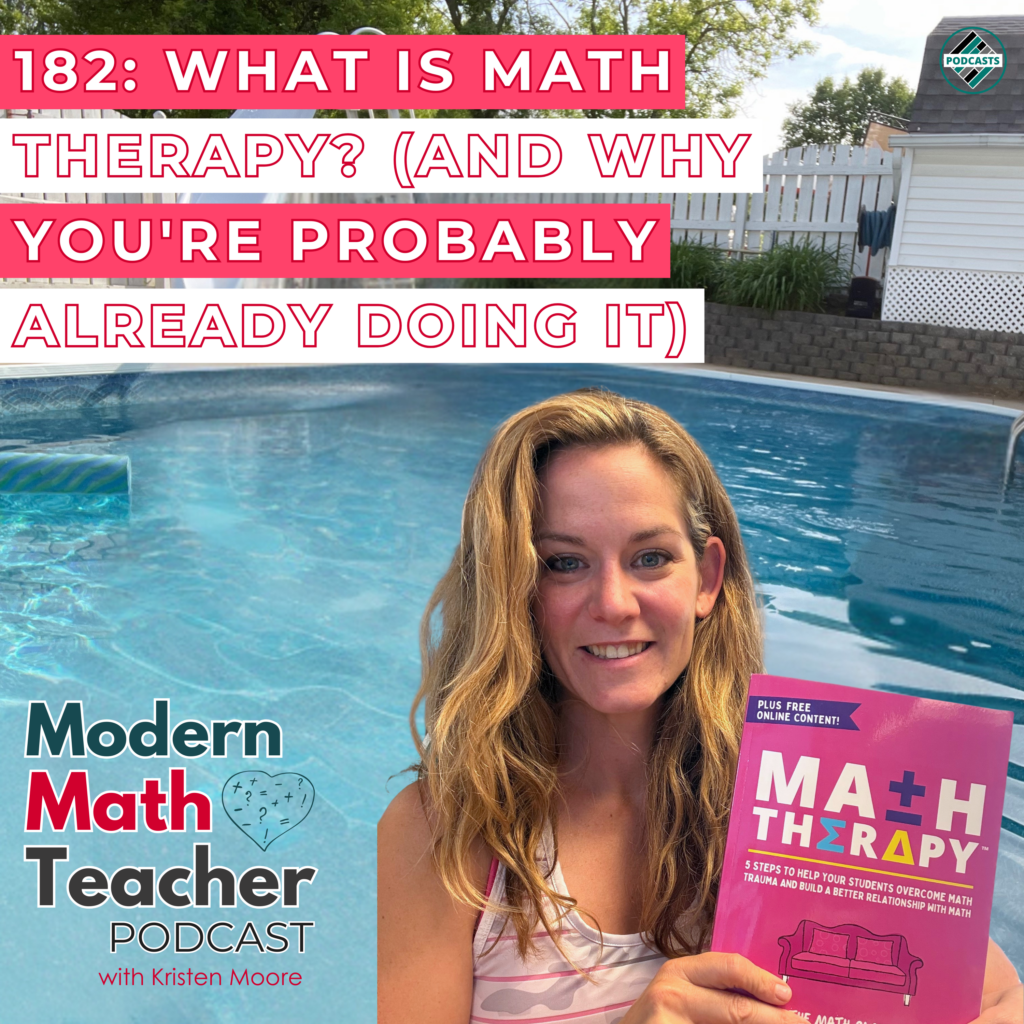
aIf someone asked me a few months ago what math therapy was, I probably would have pictured a very specialized practice done by someone with a completely different job than mine.
After reading Chapter 2 of Math Therapy by Vanessa Vakharia, I see it differently.
No, teachers aren’t therapists. We shouldn’t try to be. But we do shape the way students experience mathematics every single day, and that realization has been sitting with me ever since I finished this chapter.
You Don’t Have to Be a Therapist to Practice Math Therapy
One of my favorite parts of this chapter was learning how Vanessa Vakharia discovered math therapy.
She didn’t set out to create an entirely new field. She noticed that people were struggling with mathematics in ways that went far beyond solving equations. They were carrying fear, shame, frustration, and years of negative experiences.
She listened.
She cared.
Then she began looking for ways to help.
That story resonated with me because it’s exactly what good teachers do every day.
We help students work through frustration, encourage them after mistakes, and celebrate growth, even when it’s small. Every interaction shapes the way students think about themselves as math learners.
That’s not therapy.
But it does influence students’ relationship with mathematics.
You’re Probably Already Doing More Than You Think
One of the biggest takeaways from this chapter was realizing that many of the ideas behind math therapy already exist in great teaching.
Think about how often we encourage productive struggle instead of rescuing students.
About the conversations we have after a student says, “I’m just bad at math.”
Think about the routines we use to build confidence, normalize mistakes, and create classrooms where students feel safe sharing their thinking.
Carol Dweck’s work on growth mindset.
Jo Boaler’s research on mathematical mindsets.
Student-centered instruction.
These ideas aren’t separate from math therapy. They’re part of the same conversation.
What math therapy offers is a framework for bringing those pieces together more intentionally.
The Five Ms Offer a Roadmap
Chapter 2 introduces Vanessa’s Five Ms:
- Mythbust
- Moderate
- Motivate
- Makeover
- Measure
We’ll spend the next several weeks exploring each one in this book study, so I won’t unpack the entire framework here.
What I will say is this: I appreciated how approachable it felt.
So many educational initiatives can feel overwhelming before you even begin. This framework felt manageable. Instead of asking teachers to overhaul everything overnight, it offers a clear starting point for helping students develop a healthier relationship with math.
The Connection I Didn’t Expect
As I was reading, another book kept coming to mind: Atomic Habits by James Clear.
One of the central ideas in that book is that our beliefs shape our identity, our identity shapes our habits, and our habits shape our outcomes.
It’s easy to see that same pattern in a math classroom.
A student begins believing, “I can’t do math.”
Over time, that belief becomes part of their identity.
“I’m not a math person.”
From there, the behaviors start to make sense. They avoid challenging problems and stop asking questions. They give up more quickly because their actions match the story they’ve been telling themselves.
Reading this chapter made me wonder if math therapy is really about interrupting that cycle.
When students begin to believe they can learn mathematics, their habits start changing too.
That’s a much more powerful goal than simply helping students memorize another procedure.
The First Two Weeks of School Matter More Than We Think
This chapter completely changed how I’m thinking about the beginning of the school year.
Most of us spend those first days reviewing procedures, establishing routines, and assessing prerequisite skills.
Those things matter.
But what if we also spent that time helping students build a healthier relationship with mathematics?
That’s exactly what I’m planning to do in my Geometry Proficiency Lab.
Students will write a Math Autobiography.
We will…
- create a classroom agreement together
- talk about what success actually looks like
- journal, reflect, and begin building a classroom culture where mistakes are expected and growth is possible
Those activities aren’t separate from learning math.
They’re part of creating the conditions that make learning possible.
Belonging Comes Before Confidence
One line from this chapter kept bringing me back to other professional learning I’ve experienced over the years.
Whether it’s Capturing Kids’ Hearts, Illustrative Mathematics, or other work around classroom culture, the message is remarkably consistent.
Students learn best when they feel like they belong.
That belonging doesn’t happen because we hand students a reflection sheet or ask them to write in a journal.
It happens because we’ve created a classroom where students feel safe enough to answer honestly.
Without that foundation, even the best activities lose much of their impact.
The Quote I Can’t Stop Thinking About
The sentence that has stayed with me most from this chapter is:
“Our collective goal when implementing math therapy is to empower students to build a better relationship with math and, in doing so, with themselves.”
That idea reaches far beyond mathematics.
Many students don’t simply believe they’re bad at math. They begin believing they’re not smart, that they don’t belong, or that success is reserved for someone else.
Helping students develop a healthier relationship with math has the potential to change much more than their next test score.
It can change how they see themselves.
Reflection Questions
As you think about your own classroom, consider these questions:
- What are you already doing that aligns with math therapy?
- How do you intentionally build belonging in your classroom?
- If you devoted the first two weeks of school to helping students build a healthier relationship with mathematics, what would you do differently?
I’d also encourage you to join the conversation in our Facebook community. Share one activity you’re already using that supports students’ mathematical identity, or tell us which of the Five Ms you’re most excited to explore.
Join Our Math Therapy Book Study
Throughout July, we’re reading Math Therapy by Vanessa Vakharia together and discussing one chapter each week on the podcast.
This isn’t a chapter-by-chapter summary. It’s an opportunity to reflect on the ideas that stand out, think about how they apply to our own classrooms, and learn alongside other math teachers.
If you haven’t started reading yet, there’s still plenty of time to jump in.
Grab a copy of the book, listen to the weekly episodes, and join the conversation inside our Facebook community. I’d love to hear what resonates with you as we work through the book together.
 Physical Book: https://amzn.to/42VJRl6
 Audiobook: https://amzn.to/49nV55D
 Listen & Connect
Listen to the episode: https://www.buzzsprout.com/2187419/episodes/19430489
 Instagram: @moorethanjustx
 Join the free FB group: The Modern Math Teacher Community
 Become a Modern Math Teacher Member
 Explore more resources: www.moorethanjustx.com