When we think about math trauma, it’s easy to picture a single negative experience. A failed test. An embarrassing moment at the board. A teacher who made a student feel small.
But after reading the first chapter of Math Therapy by Vanessa Vakharia, I found myself thinking about something different.
The chapter wasn’t just about defining math trauma. It was about the stories people carry with them long before they walk into our classrooms.
Those stories shape confidence. They influence risk-taking. They affect how students respond when learning gets difficult.
As I reflected on the chapter, I realized that many of the beliefs students have about mathematics didn’t begin in school. They started years earlier through conversations, experiences, and messages they’ve heard over and over again.
“Math Class Is Tough”
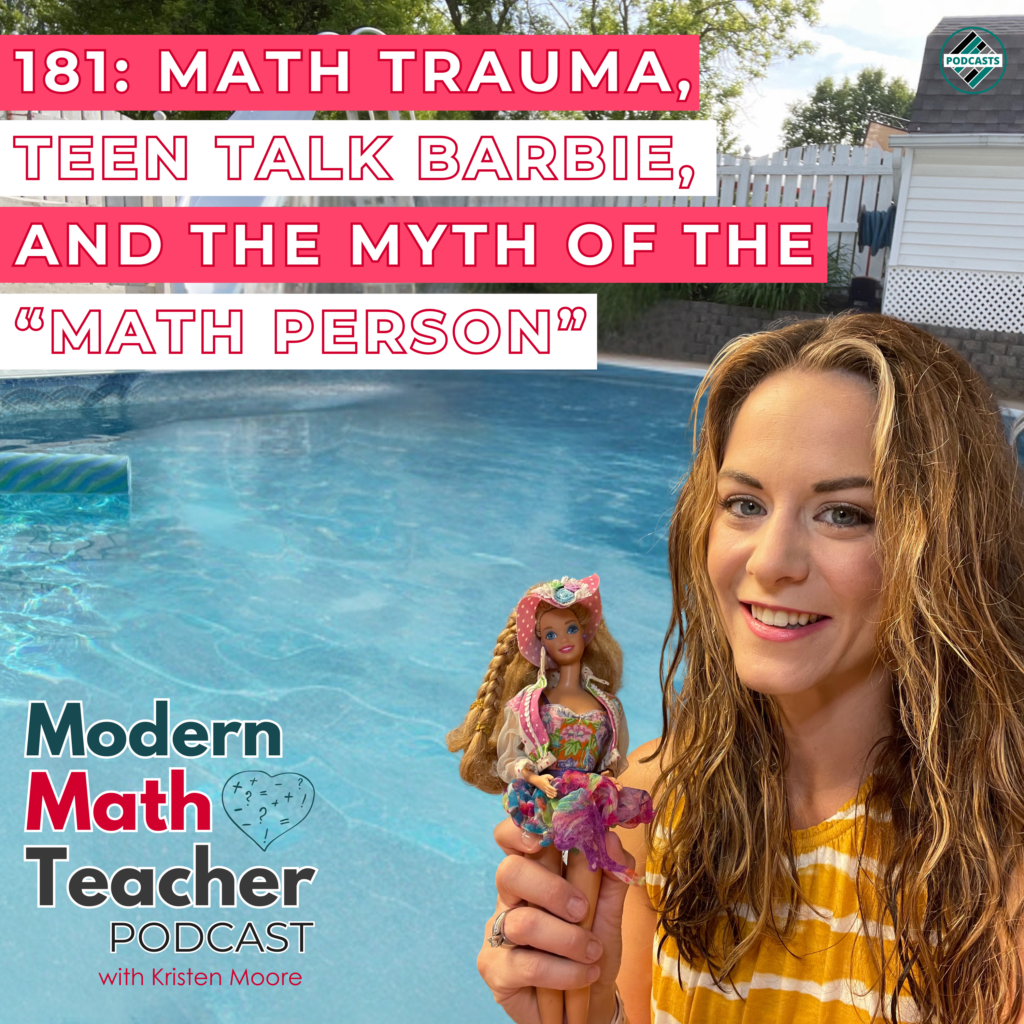
One of my favorite moments in the chapter was seeing Vanessa mention Teen Talk Barbie. If you grew up in the ’90s, you probably remember the controversy surrounding one of the doll’s phrases:
“Math class is tough.”
The criticism made sense. Many people worried it reinforced stereotypes about girls and mathematics.
Still, I don’t think the biggest problem was the statement itself.
Math is tough.
Learning something new is supposed to feel challenging.
The problem was the message underneath it.
If math is hard, maybe you’re just not a math person.
If you’re struggling, maybe you don’t belong.
A few weeks before reading this chapter, I hosted a Lunch and Learn about productive struggle. We talked about this exact quote and gave it a different ending:
Math class is tough. And so am I.
That small shift changes everything.
Productive struggle isn’t proof that students can’t do mathematics. It’s often evidence that they’re doing the hard work of learning.
The Myth of the “Math Person”
Another idea that stayed with me was the belief that some people are simply born good at math.
People have assumed that about me for years.
Both of my parents worked in math-related careers, so it’s easy to believe I inherited some kind of “math gene.”
When I think back on my childhood, though, that’s not what I remember.
I remember exposure.
Every Friday night, my family went out to eat, and my parents asked us to calculate the tip. They weren’t trying to create future mathematicians. They were simply treating math like a normal part of everyday life.
We talked about it, used it, and practiced it without even realizing we were practicing.
That memory has made me wonder how much of what we call mathematical ability is actually mathematical exposure.
How many students have simply had fewer opportunities to see themselves as capable mathematicians?
Students Hear Messages About Math Everywhere
One activity Vanessa suggests is paying attention to the messages about mathematics that appear in everyday life.
Once I started thinking about it, I realized those messages are everywhere.
We hear people say:
- “I’m just not a math person.”
- “I’ve never used algebra.”
- “I was terrible at math.”
- “Some people just have a math brain.”
Students hear these comments from family members, friends, television shows, commercials, and social media.
By the time they enter our classrooms, many have already decided what kind of math learner they are.
Those beliefs didn’t develop overnight, and they won’t disappear overnight either.
Students Bring More Than Math Skills Into the Classroom
One distinction Vanessa makes is between math anxiety and math trauma.
I won’t unpack the entire chapter here because I hope you’ll read it yourself, but one idea immediately connected with my own teaching.
Students don’t enter our classrooms as blank slates.
They arrive carrying experiences, labels, memories, and expectations.
I see this all the time with my Geometry Proficiency Lab students.
Before we’ve solved a single problem together, many already believe they know how the year will go.
- “I’m behind.”
- “I’m bad at math.”
- “I’m not one of the smart kids.”
Those beliefs often become a bigger obstacle than the content itself. Teaching mathematics matters, of course. Helping students rebuild confidence matters just as much.
Does Math Trauma Look Different for Different Students?
One question has been sitting with me since I finished the chapter.
Does math trauma look different depending on the students in front of us?
I’ve seen avoidance, frustration, and low confidence in intervention classes.
What about honors classes?
Maybe the behaviors look different.
Students in intervention classes may avoid difficult tasks altogether.
Students in honors classes may chase perfection, fear mistakes, or place enormous pressure on themselves to always succeed.
The behaviors aren’t identical, but I wonder if the underlying emotions are more similar than we realize.
That’s a question I’ll keep exploring throughout this book study.
Reflection Questions
As I finished Chapter 1, I found myself thinking less about definitions and more about experiences.
Here are a few questions I’m continuing to wrestle with:
- What messages about mathematics shaped your own relationship with math?
- Were you encouraged to believe you could learn math, or were you taught that mathematical ability was something you either had or didn’t?
- Where do you see math anxiety, stress, or math trauma showing up in your students?
These aren’t questions with quick answers.
They’re invitations to notice the stories students bring into our classrooms and consider how those stories influence learning.
Join the Math Therapy Book Study
This summer, I’m reading Math Therapy by Vanessa Vakharia one chapter at a time, and I’d love for you to read along with me.
These blog posts aren’t chapter summaries. They’re conversations about the ideas that stand out, the questions they raise, and the ways they’re shaping my own classroom.
This week’s challenge is simple.
Pay attention to the messages about mathematics you encounter throughout the week.
Listen to conversations. Watch commercials. Notice television shows and social media posts.
What are people saying about math?
Then come share your observations inside our Facebook community. I’d love to hear what you’re noticing and continue the conversation together.
If you haven’t picked up the book yet, there’s still plenty of time to join us before next week’s discussion.
 Listen & Connect
 Listen to the episode: https://www.buzzsprout.com/2187419/episodes/19430479
 Instagram: @moorethanjustx
 Join the free FB group: The Modern Math Teacher Community
 Become a Modern Math Teacher Member
 Explore more resources: www.moorethanjustx.com