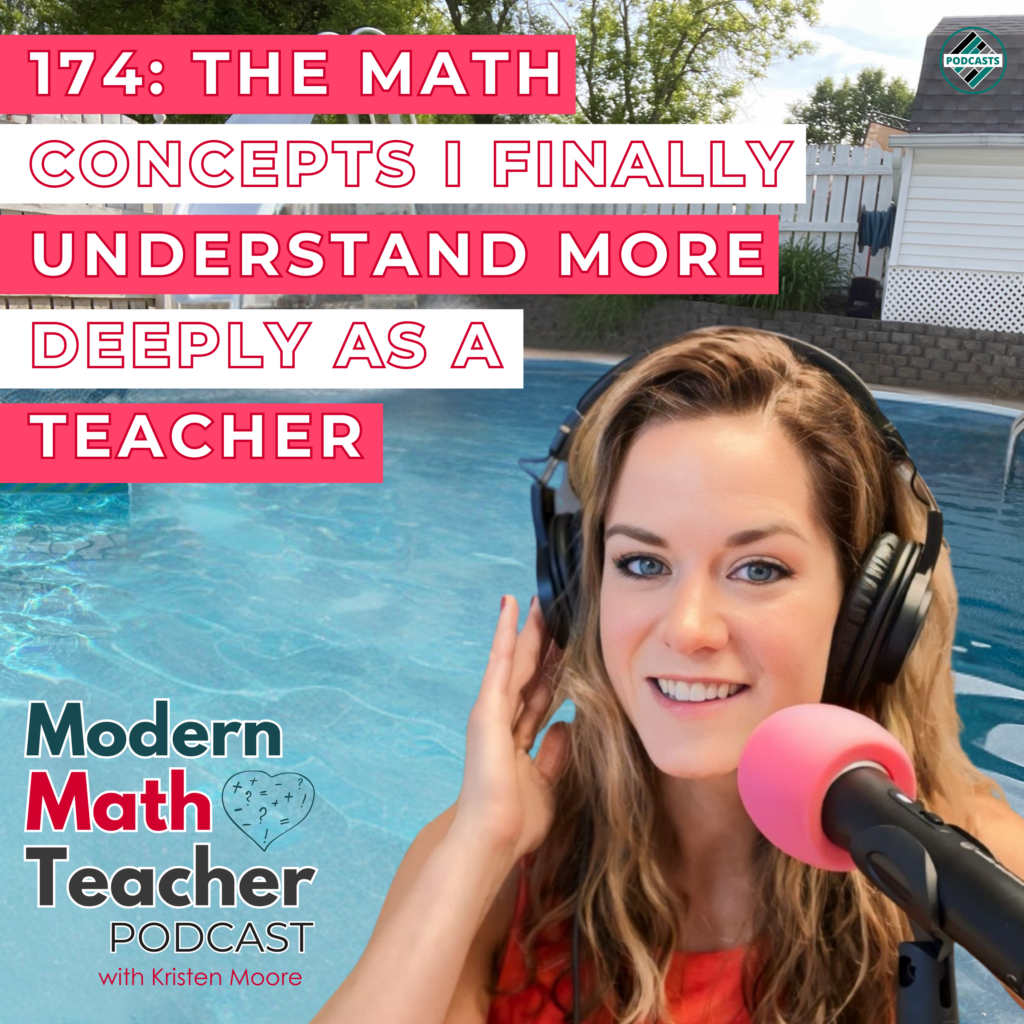
There are math concepts I taught for years before I developed true conceptual understanding in math.
I could teach the procedure, explain the steps, and help students arrive at the correct answer. But understanding why those procedures worked was a completely different story.
This year changed that.
Between piloting a new curriculum, beginning National Board Certification, and spending more time thinking intentionally about how students learn mathematics, I found myself revisiting ideas I had taught countless times before.
What surprised me most was how often I discovered a deeper layer of understanding waiting underneath the procedures I had memorized years ago. And I know I’m not the only teacher who has experienced that.
Why Conceptual Understanding in Math Matters More Than Memorization
Many of us became successful math students because we were good at following procedures.
We learned formulas, memorized steps, and recognized patterns. For a long time, that was enough.
The challenge comes when students start asking questions that go beyond the procedure.
- Why does this work?
- Why does the rule look like that?
- Why does changing this part of the equation create that result?
Those questions require something more than procedural fluency. They require conceptual understanding in math.
As teachers, we’re not just helping students arrive at answers. We’re helping them make sense of ideas. That work becomes much harder when we haven’t had opportunities to develop our own conceptual understanding.
The Concept That Broke My Brain
One of the biggest examples for me this year was function transformations, especially horizontal transformations.
If you’ve taught Algebra 2, you probably know exactly what I’m talking about.
Move right with a minus.
Move left with a plus.
Stretch horizontally by multiplying by one-half.
For years, I taught those rules successfully.
Students wrote them down. We practiced them. They applied them. But if I’m being honest, there was a long stretch of time when I couldn’t fully explain why those transformations behaved the way they did.
This year, I spent much more time wrestling with the underlying concepts. The breakthrough came when I stopped focusing on the graph and started thinking about inputs and outputs. When you want the same output to occur at a different location, you have to adjust the input. Once I began viewing transformations through that lens, the rules stopped feeling random. They started making sense.
That experience reminded me of something important: some mathematical ideas are genuinely difficult.
Students aren’t confused because they aren’t trying hard enough.
They’re confused because abstract thinking is challenging.
Working through that struggle myself made me much more empathetic toward the students sitting in my classroom.
The Story Behind the Number System
Another concept that fascinated me this year was the evolution of the number system.
As a student, I never spent much time thinking about where different types of numbers came from.
We learned them, used them, and then we moved on.
Now, I find the story behind them fascinating.
Whole numbers worked until they didn’t.
Then fractions became necessary.
Later, mathematicians needed negative numbers, irrational numbers, and eventually complex numbers.
Each expansion of the number system happened because people encountered a problem they couldn’t solve using the tools they already had.
That changes the way I think about mathematics.
Math isn’t just a collection of rules handed down from generation to generation.
It’s a record of people trying to make sense of increasingly complicated problems.
When students see mathematics through that lens, it feels more human. It feels more connected. It feels like something that evolved rather than something that simply exists.
Deeper Understanding Changed My Instruction
One of the biggest surprises this year was realizing how much deeper content knowledge impacts instructional decisions.
When I understood concepts more deeply, I started asking different questions during planning.
Instead of focusing solely on what students needed to do, I found myself thinking about:
- What misconceptions are likely to appear?
- What prior knowledge do students need?
- What future concepts connect to this lesson?
- Why might students struggle with this idea?
Those questions led to better conversations and more intentional instruction.
Teaching multiple grade levels over the years has helped me see mathematics as a connected progression rather than a collection of isolated units.
Students are constantly building on previous ideas while preparing for future ones.
The more clearly we can see those connections, the better we can help students make sense of what they’re learning.
Why Every Math Teacher Should Study Beyond Their Grade Level
One lesson I’m taking with me moving forward is the importance of studying both above and below the courses we teach.
You don’t need to become an expert in every area of mathematics, but understanding where concepts come from and where they’re headed can completely change the way you teach them.
It helps you:
- Activate prior knowledge more effectively
- Anticipate misconceptions
- Emphasize the most important ideas
- Show students how concepts connect over time
Most importantly, it strengthens your own conceptual understanding in math, which ultimately strengthens your instruction. Teaching becomes much more interesting when you see the bigger mathematical story unfolding across grade levels.
Teachers Are Learners Too
One of my biggest takeaways from this year is that teaching math well requires continual learning.
The more deeply we understand mathematics, the more thoughtfully we can help students understand it too.
I used to think expertise meant having all the answers.
Now I think expertise looks more like curiosity.
It looks like continuing to ask questions and revisiting concepts you’ve taught for years and discovering something new.
The more deeply we develop our own conceptual understanding in math, the more effectively we can help students build theirs.
And honestly, I think that makes us better teachers.
Not perfect teachers.
Better ones.
📘 Join the July Book Study
If this conversation about conceptual understanding, math identity, and how students experience mathematics resonates with you, I’d love for you to join us for our July book study.
We’ll be reading Math Therapy together and discussing topics like:
- Math identity
- Confidence and self-belief
- Productive struggle
- Emotional experiences in math classrooms
- Creating learning environments where students feel capable and supported
It’s a conversation I’m incredibly excited to have because mathematics is about so much more than procedures and correct answers.
The way students experience math shapes the way they see themselves as learners.
And that’s worth exploring.
Grab the book here:
📖 Physical book:
https://amzn.to/42VJRl6
🎧 Audiobook:
https://amzn.to/49nV55D
Want More Support?
If you’re trying to create more meaningful learning experiences in your classroom and you’re not always sure when to use projects, performance tasks, or traditional practice, I’ve created a free guide to help.
Project or Practice? walks you through how to make intentional instructional decisions without adding more to your plate.
👉 Download it here:
https://moorethanjustx.myflodesk.com/practice
 Listen & Connect
 Listen to the episode: https://www.buzzsprout.com/2187419/episodes/19313677
 Instagram: @moorethanjustx
 Join the free FB group: The Modern Math Teacher Community
 Become a Modern Math Teacher Member
 Explore more resources: www.moorethanjustx.com