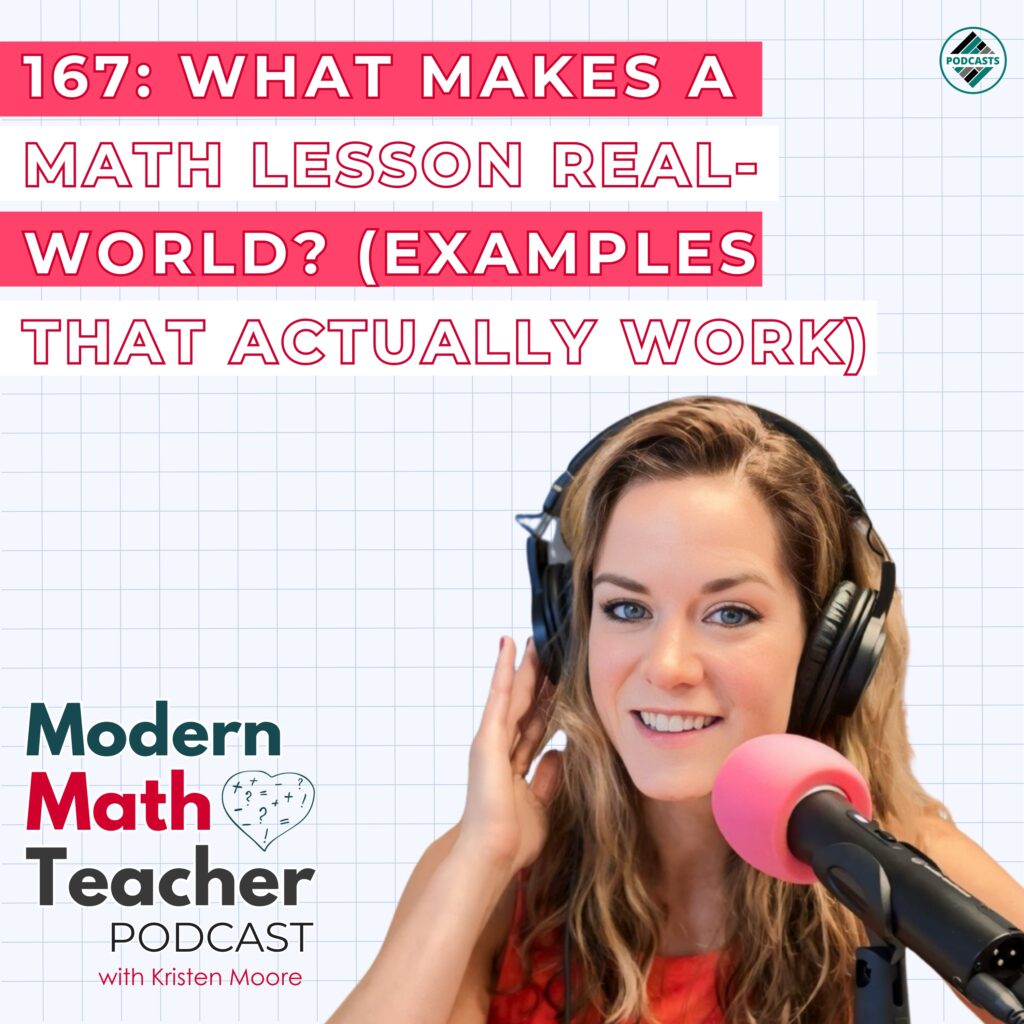
Let’s be honest.
Most real world math problems… aren’t actually real.
You’ve seen them before:
A train leaving the station at 3:00 PM.
Someone buying 47 watermelons.
A random shopping scenario no one would ever care about.
Technically, those examples use math.
But to students?
They feel fake.
And when students feel like a lesson is fake, forced, or disconnected, engagement drops quickly.
So if you’ve ever tried to make your lessons more “real-world” and it still felt off, you’re not doing anything wrong.
You’ve probably just been handed the wrong definition of what real world math problems should be.
 If this is speaking to you, but listening works better than reading right now, you can hear the full episode here.
Why Most Real World Math Problems Miss the Mark
The biggest issue with many classroom tasks is this:
They focus on context instead of connection.
We take a traditional math problem and wrap it in a story about:
- shopping
- sports
- travel
- money
But the math experience itself doesn’t change. Students are still just plugging numbers into formulas or following steps they don’t fully understand. There’s no real decision being made.
No authentic purpose.
No reason to care.
So while it may look like one of those real world math problems, it doesn’t feel real to students.
And students know the difference.
What Actually Makes a Math Lesson Feel Real
A lesson feels real when students can clearly see three things:
1. How the Math Connects Outside the Classroom
Students need to understand where this concept shows up beyond school.
Not in a vague “you’ll need this someday” kind of way.
In a believable, concrete way.
2. How the Math Could Actually Be Used
Would someone use this math to compare options, make a decision, solve a problem, or analyze something important?
That’s what creates meaning.
3. Why It Matters
Students don’t need every lesson to be life-changing.
But they do need to understand why the learning has value.
That’s the difference between doing math and making sense of math.
A Quick Test for Better Real World Math Problems
Before using a task, ask yourself these three questions:
- Would someone actually use math like this in real life?
- Is there a real decision being made?
- Would my students recognize or care about this situation?
If the answer is no, the task may need a small redesign.
This quick filter can instantly improve the quality of your real world math problems without requiring hours of planning.
Real-World Doesn’t Mean You Need to Start Over
This is where many teachers get stuck.
They assume creating better lessons means:
- rewriting units
- building giant projects
- starting from scratch
- spending hours planning
You do not need to do any of that.
Often, the best improvements come from reworking what you already have.
Try:
- changing the context
- adding a real choice or decision
- asking students to justify a recommendation
- making the numbers more believable
- connecting it to something students recognize
Small shifts can make existing lessons feel far more authentic.
Examples That Actually Work
Here’s what stronger real world math problems can look like:
Instead of:
Find the unit rate of two phone plans.
Try:
Which phone plan would be better for a student with a part-time job and a limited budget? Explain your reasoning.
Instead of:
Calculate area of a rectangle.
Try:
You’re redesigning a bedroom layout. Which rug sizes fit best while staying under budget?
Instead of:
Solve a system of equations.
Try:
Compare two fundraiser pricing options and determine when each one makes more sense.
Notice the difference?
Students are no longer just solving.
They’re thinking, deciding, and applying.
A Small Shift to Try This Week
Take one problem you already plan to use and ask:
- What is the student actually doing here?
- Could this involve a real decision?
- How could this feel more believable or familiar?
You do not need a full project.
Sometimes you just need a better entry point.
What We’re Really Building
This work is about more than engagement.
It’s about designing math experiences that are:
- real
- relevant
- rigorous
Because when students see purpose, they participate differently.
They think deeper, ask better questions, and remember more.
Want Help Balancing Real-World Learning with a Real Curriculum?
I created a free guide to help you decide when to use projects vs. practice in your math classroom, so you can create meaningful lessons without overcomplicating everything.
Grab it here:
https://moorethanjustx.myflodesk.com/practice
Until next time, keep it real.
 Listen & Connect
Listen to the episode: https://www.buzzsprout.com/2187419/episodes/18971206
 Instagram: @moorethanjustx
 Join the free FB group: The Modern Math Teacher Community
 Become a Modern Math Teacher Member
 Explore more resources: www.moorethanjustx.com