Over the last several weeks, we’ve been deep in the work of productive math struggle.
We’ve talked about what it means to value struggle.
To build math identity.
Create classroom community.
Plan for thinking.
Support students in the moment.
Reflect in ways that actually stick.
And this series hasn’t just lived on the podcast.
It’s connected so closely to the work I’ve been doing in my district and across our county… supporting teachers as we intentionally shift instruction to better support productive struggle in real classrooms, with real students, during real constraints.
As part of that work, I invited educators to share the questions they’re actually wrestling with.
Not theoretical ones.
The practical ones.
The “it’s third hour and my kids are shutting down” ones.
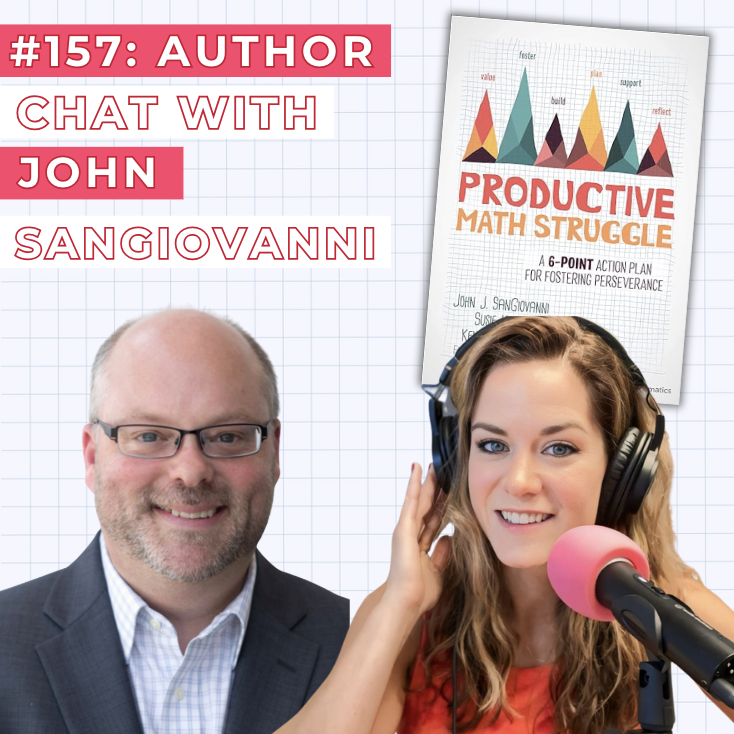
And in this capstone conversation, I sat down with John SanGiovanni, co-author of Productive Math Struggle, to unpack those questions together.
What follows isn’t a recap.
It’s what stayed with me.
Why Productive Struggle Feels Urgent (Again)
We talked about how the book came out in 2020, a year that reshaped education in ways we’re still navigating.
But here’s the truth John named that hit me:
Teaching has always been hard.
2019 was hard.
2014 was hard.
The late 90s were hard.
The challenges shift, but the work remains intense.
What feels especially urgent right now is this:
We have students who are struggling to find a foothold in math, and we’re tempted to see that only as a deficit.
But there’s opportunity there.
Opportunity to help them build agency.
To deepen understanding.
To develop perseverance that transfers beyond math class.
That doesn’t happen by removing struggle.
It happens by redefining it.
One Small Shift That Changes Everything
One of the teacher questions I brought to John was this:
What is one low-prep move teachers could make tomorrow that would meaningfully impact student thinking?
His answer was deceptively simple:
Do the task yourself. Then anticipate what students might do.
Before the lesson.
Before the moment.
Before the struggle shows up.
That shift… anticipating strategies, misconceptions, likely sticking points… moves us from reacting to struggle to planning for it.
Struggle isn’t just something we respond to.
It’s something we can prepare for.
As someone piloting new curriculum right now, I’ve felt this deeply. When I’ve worked through tasks ahead of time, with colleagues, I’m simply better positioned in the moment.
It’s not about perfection.
It’s about intention.
“I’m Just Not Good at Math.”
If you teach middle or high school, you know this line.
And John said something that stopped me:
Some of our students have six years of evidence that math isn’t for them.
We can’t just say, “You can do it!” and expect identity to shift.
Repairing math identity takes time.
It requires:
-
Knowing students beyond their test scores
-
Naming strengths that aren’t just about calculation
-
Giving space for thinking that doesn’t look like traditional math
Much of the work of supporting productive struggle happens before students get stuck.
That reframing matters.
When Do You Step In?
Another question teachers asked:
How do you know when to step in during struggle, and when to hold back?
The honest answer?
There isn’t a formula.
It’s relational.
It’s responsive.
It’s knowing your students and noticing how they’re changing over time.
Some days you’ll step in too soon.
Some days you’ll wait too long.
Some days you’ll get it just right.
The key is reflection.
Not just on content, but on moments.
-
What worked?
-
Who did it work for?
-
What move did I make that shifted the room?
Those micro-reflections build our professional judgment.
The Myth of “One Best Way”
During our rapid-fire questions, I asked:
What belief about math teaching do you wish would change systemwide?
John didn’t hesitate… The idea that there’s one best way to do math.
Humans are divergent thinkers. Trying to force uniformity into something inherently flexible doesn’t build thinkers, it builds compliance. And we’ve historically valued speed over sense-making.
But here’s the bridge analogy he shared that I can’t stop thinking about: You don’t drive across a bridge hoping it was built quickly. Why is math the only place where faster equals smarter?
That belief deserves disruption.
What Gives Me Hope
I asked what keeps him optimistic about math education right now.
His answer?
Teachers.
Teachers who show up.
Who learn.
Who stay vulnerable.
Who admit they don’t have it all figured out.
And that resonated deeply.
Because that’s what I see in our district work.
Teachers asking hard questions.
Trying new moves.
Rebuilding community mid-year.
Reflecting between classes in 10-minute hallway conversations.
That’s the work that moves us forward.
Redefining Struggle at the System Level
For leaders, the question becomes:
How do we help teachers and students redefine struggle as necessary, not negative?
It starts with valuing it.
But it also requires structures:
-
Collaborative planning that goes beyond dividing tasks
-
Measuring and nurturing student dispositions
-
Giving teachers permission to reinvest in community throughout the year
-
Partnering with parents so they understand why thinking matters more than speed
We don’t just teach math content.
We teach humans.
And productive struggle develops more than procedural skill, it builds self-efficacy.
What I’m Walking Away With
If there’s one thread that runs through this entire conversation, it’s this:
Productive struggle isn’t a strategy.
It’s a stance.
It’s believing that:
-
Students are capable.
-
Thinking is worth time.
-
Community matters.
-
Speed is not the goal.
-
Struggle has value — and we must value it.
And maybe most importantly?
We don’t have to overhaul everything tomorrow.
We can take one move.
One anticipation.
One reflective moment.
One identity-building conversation.
And start there.
If you’re in the middle of navigating this shift in your own classroom — you’re not alone.
We’re all still learning.
And as always…
Keep it real. 💛📐
 Read along with Us
 Listen & Connect
 Listen here
 Instagram: @moorethanjustx
 Join the free FB group: The Modern Math Teacher Community
 Become a Modern Math Teacher Member
 Explore more resources: www.moorethanjustx.com