Let’s be honest.
Planning for productive struggle is one thing. Supporting it in the moment—when students are frustrated, stuck, or staring at you with that please just tell me look—is where even experienced teachers start to question every move.
I hear this all the time: Do I step in? Do I wait? Do I give a hint? Do I rescue this before it falls apart?
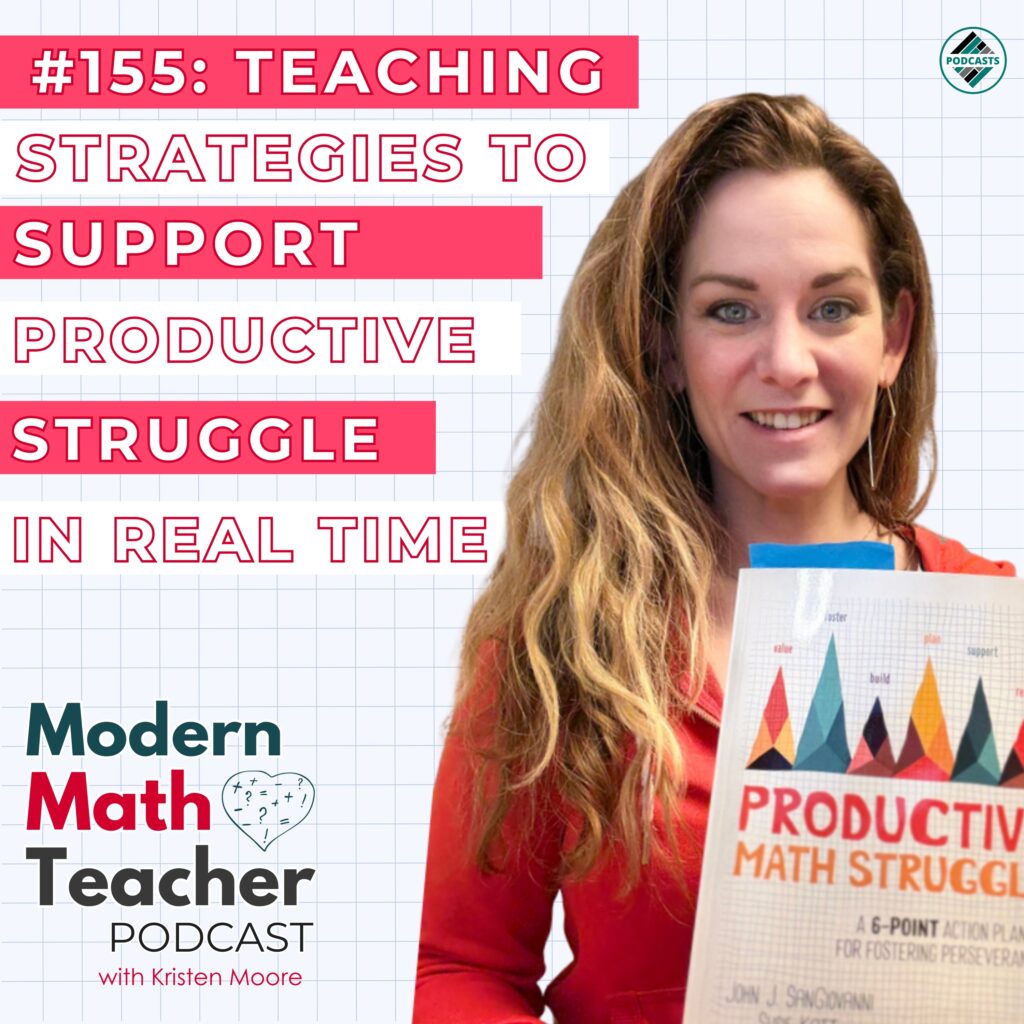
🎧 In this episode of the Modern Math Teacher Podcast, I break down a small-but-mighty set of teaching strategies I rely on to keep struggle productive—not painful—during the lesson itself. These are the moves I use in real classrooms, with real students, when the clock is ticking and the pressure is real.
Below is a preview of each move… not the full playbook, but just enough to help you recognize what’s possible when struggle is supported intentionally.
First: Not All Struggle Is the Same
One of the biggest mistakes I see teachers make (and one I’ve made myself) is assuming all struggle looks alike.
It doesn’t.
Some students can’t get started. Some can’t choose a strategy. Some can’t calculate. Some can’t explain their thinking. And when we don’t name the type of struggle, we usually respond in ways that don’t actually help.
One of the most powerful teaching strategies is simply learning to notice what kind of stuck you’re seeing. That clarity changes everything about how you respond.
Move #1: Rescue Thinking, Not Answers
This is the heart of supporting productive struggle.
When I rescue answers, learning stops. When I rescue thinking, students stay in control.
This move isn’t about being hands-off or refusing to help… it’s about choosing questions, prompts, and representations that keep students reasoning instead of mimicking. The difference is subtle, but the impact is huge.
If students leave your class dependent on you to move forward, the struggle wasn’t productive. This move is about changing that trajectory.
Move #2: Catch and Release
There are moments when individual support just isn’t enough… when patterns of confusion start to spread across the room.
That’s where one of my favorite whole-class teaching strategies comes in.
Instead of reteaching the lesson five times at five tables, I pause the class, surface student thinking, and then send them right back into the work with clarity and momentum.
When used intentionally, this move:
- normalizes struggle
- centers student voice
- prevents frustration from spiraling
- and strengthens classroom community
Move #3: Referrals (Stop Being the Walking Answer Key)
Supporting struggle does not mean becoming the sole source of help.
One of my goals as a teacher is to show students where to look when they’re stuck… tools, representations, peers, and strategies they can rely on independently.
Referrals are teaching strategies that build agency. Over time, students stop asking “Is this right?” and start asking “What should I try next?”
That shift matters.
Move #4: Metacognitive Micro-Questions
When students freeze, they don’t usually need an explanation.
They need help untangling their thinking.
Small, intentional questions can reduce anxiety, restart reasoning, and prevent shutdown, all without lowering the cognitive demand of the task. These micro-questions are quick, powerful, and incredibly effective when used at the right moment.
This is one of those teaching strategies that quietly changes everything.
Move #5: Honor Mistakes
If mistakes aren’t safe, struggle isn’t productive.
Mistakes are information. They tell us what students understand, how they’re reasoning, and where misconceptions live. When we slow down and honor them, we build trust… and trust is the foundation of every strong classroom community.
This move isn’t about celebrating being wrong. It’s about protecting student dignity while deepening learning.
The Real Skill: Knowing When to Help and When to Hold Back
There’s no script for this part.
Supporting productive struggle is an art. It’s knowing when a small nudge will unlock thinking,and when explaining would rob students of the opportunity to learn.
Your job isn’t to eliminate struggle. Your job is to keep it productive.
 Mini Move of the Week
The next time a student is stuck, don’t explain.
👉 Ask ONE metacognitive micro-question when a student gets stuck, and then wait…
That pause is often where learning begins.
If you want to explore how these teaching strategies sound, feel, and function inside real math classrooms, including the teacher language and timing that make them work, this conversation continues beyond the page.
 Read along with Us
 Listen & Connect
 Listen here: https://www.buzzsprout.com/2187419/episodes/18427422
 Instagram: @moorethanjustx
 Join the free FB group: The Modern Math Teacher Community
 Become a Modern Math Teacher Member
 Explore more resources: www.moorethanjustx.com