Let me start with a question I know a lot of math teachers are quietly asking right now:
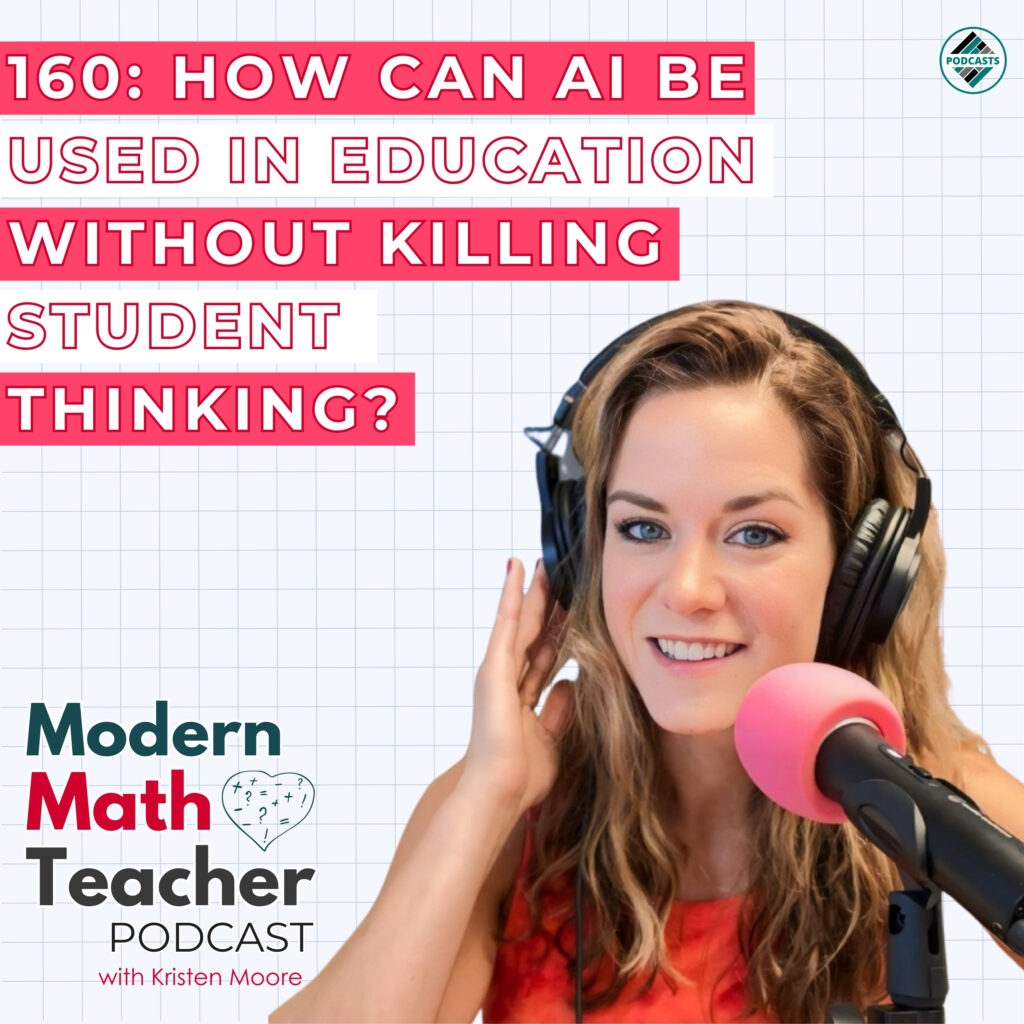
How can AI be used in education without killing student thinking?
Because if we’re honest, many teachers didn’t greet AI with excitement. The first reaction was concern.
Concern about shortcuts.
Concern about cheating.
Concern about students skipping the thinking altogether.
And honestly? Those concerns make sense.
Math teachers spend so much time protecting the very things AI seems capable of bypassing… productive struggle, reasoning, and sense-making. When a tool can instantly generate answers or explanations, it can feel like a direct threat to the learning environment we’re trying to build.
But here’s the distinction I want to slow down and explore in this episode:
AI itself isn’t the problem.
How we use it (and why) is what matters.
Why AI Feels So Loaded for Math Teachers
I think part of why AI feels so loaded is because math teachers already carry a lot of responsibility around thinking.
We fight for:
- Productive struggle
- Sense-making
- Students explaining their reasoning
So when a tool shows up that can instantly generate answers, explanations, or solutions, it feels like a direct threat to everything we’ve been trying to build.
Along with the early conversations about AI sounding like… “It can write lessons for you” or “It can do the grading”… it put many teachers immediately on the defensive.
Because the goal isn’t less thinking in math classrooms.
The goal is better thinking.
The Real Risk: AI as a Thinking Replacement
Most of the scary AI stories in education come from the same place: using AI as a thinking replacement.
When students use AI to:
-
Solve the problem
-
Write the explanation
-
Provide the answer
Of course it undermines learning.
But that outcome isn’t really about the technology.
It’s about how the tool is being used.
And that distinction matters.
Because when AI is used differently (intentionally) it can actually support the work teachers are already trying to do.
The Reframe: AI Should Support Teacher Thinking
One of the most important mindset shifts in this conversation is this:
AI works best when it supports teacher thinking… not when it replaces student thinking.
Some of the most powerful uses of AI happen before the lesson even begins.
For example, teachers might use AI to:
-
Anticipate common student misconceptions
-
Generate multiple entry points for a task
-
Draft reflection questions that push reasoning
-
Plan feedback stems that keep thinking with students
Notice what AI isn’t doing in those situations.
It isn’t:
-
Teaching the lesson
-
Explaining the math to students
-
Doing the thinking for them
Instead, it’s helping teachers prepare for thinking more intentionally.
That’s where AI literacy becomes so important… understanding not just what tools exist, but how to use them responsibly.
Where AI Fits with Productive Struggle
If you’ve been following along with the recent podcast episodes on productive struggle, this is where AI can actually fit in a really powerful way.
Productive struggle doesn’t happen accidentally.
It requires thoughtful planning:
-
Designing tasks with multiple entry points
-
Anticipating where students might get stuck
-
Preparing questions that move thinking forward
-
Planning feedback that supports reasoning
Those are complex parts of teaching.
And they’re exactly the kinds of planning tasks where AI can help teachers think more clearly and more efficiently.
In other words, AI can support the instructional design that protects student thinking, not replace the thinking itself.
What Responsible AI Use Actually Looks Like
When we talk about AI in education, the real question isn’t “Should teachers use it?”
The better question is:
How do we use it responsibly?
Responsible AI use:
-
Protects student thinking
-
Strengthens instructional design
-
Reduces teacher cognitive load
Irresponsible AI use:
-
Skips sense-making
-
Replaces explanation with answers
-
Removes productive struggle
The difference isn’t the tool.
It’s the intention behind the tool.
The Conversation Teachers Need Right Now
AI isn’t going away.
But that doesn’t mean it has to undermine good teaching.
When used thoughtfully, AI can actually help protect the things math teachers care about most:
-
Student reasoning
-
Productive struggle
-
Meaningful learning
In this episode, I dig deeper into what responsible AI use in math classrooms really looks like, and how teachers can start experimenting with AI in ways that support thinking rather than replace it.
Because the real opportunity here isn’t replacing teachers or student thinking.
It’s helping teachers design learning experiences even more intentionally.
 Listen & Connect
 Listen to the episode
 Instagram: @moorethanjustx
 Join the free FB group: The Modern Math Teacher Community
 Become a Modern Math Teacher Member
 Explore more resources: www.moorethanjustx.com
Want to go deeper?
🎟️ Join me for a hands-on AI training with BER (March or April) where teachers actively create lessons and materials.
🎁 Can’t attend live? Download the Ultimate AI Tools for Math Teachers Guide instead.