Let me start with a question.
Have you ever planned a lesson that felt just right? The task was solid. The math was rich. Students were talking, trying things, getting stuck, revising, debating. And in that moment, you thought, Yes. This is what productive struggle is supposed to look like.
But then later… maybe that afternoon, or the next day… you had that little nagging doubt:
Did any of that actually stick?
Do they really know what they were supposed to learn?
Did the struggle turn into understanding… or just effort?
I want you to know something: that moment of uncertainty doesn’t mean your lesson failed. It means you’re asking the right question. Productive struggle is powerful, but it’s not the finish line.
Struggle Is the Middle, Not the Goal
Over the past few weeks on The Modern Math Teacher Podcast, I’ve been talking a lot about productive struggle… how to plan for it, launch tasks that invite thinking, and resist the urge to rescue students too quickly. All of that matters.
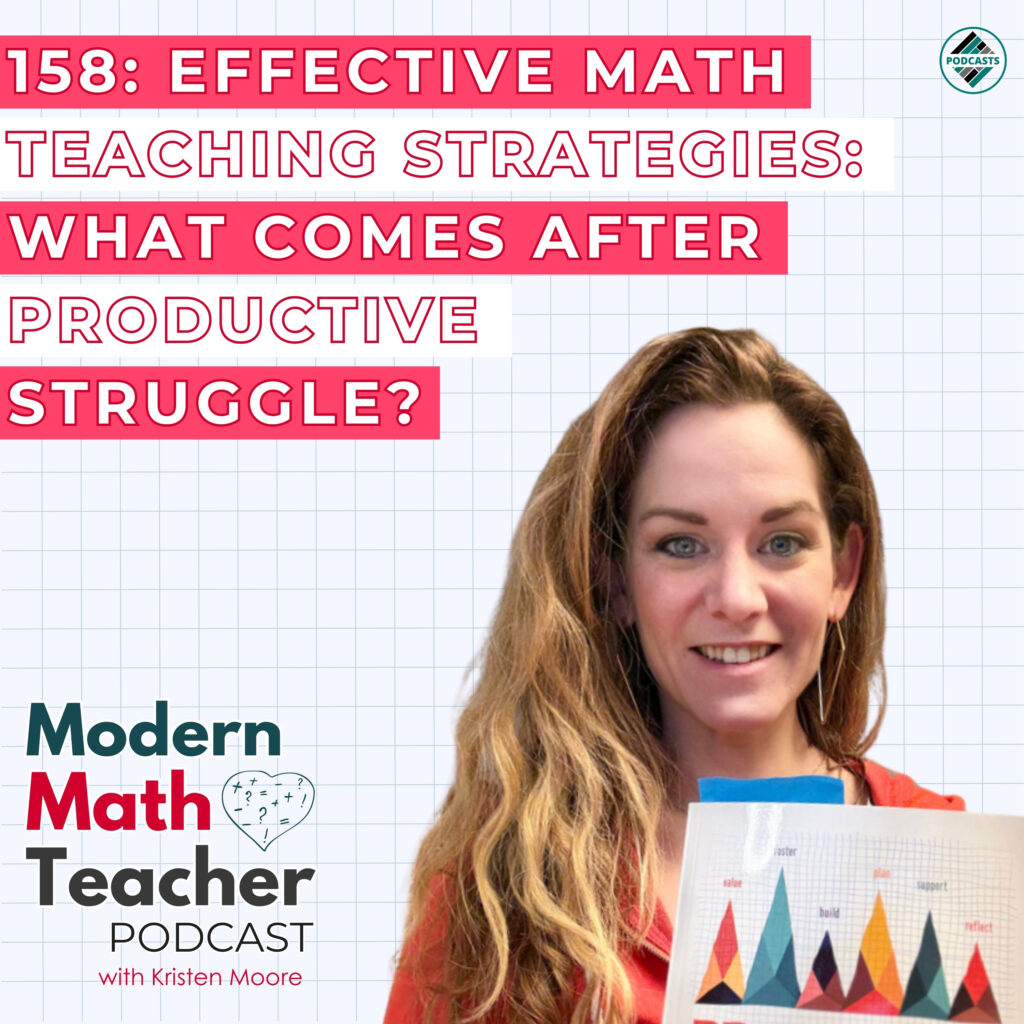
But here’s the thing we don’t always say out loud: struggle by itself doesn’t guarantee learning. Struggle is the experience. Learning is what students take with them afterward. And the bridge between the two is where effective math teaching strategies really live.
If we don’t plan intentionally for what comes after the struggle, here’s what can happen:
-
Students walk away unsure what actually mattered
-
They remember the activity, but not the math
-
Or they feel like they worked hard without growing
It’s not that struggle was a bad choice, it’s that the learning wasn’t fully consolidated.
Three Instructional Teaching Strategies That Must Follow Struggle
This is the part where your lessons move from “good” to “really good.” After students struggle, we have to be intentional about what comes next.
1️⃣ Reflection: Making Meaning of the Experience
Reflection is the step that often gets skipped, but it’s essential. After a challenging task, students need space to answer questions like:
-
What did I try?
-
What worked?
-
What didn’t work, and why?
-
What would I do differently next time?
This isn’t about grading or getting the “right answer.” It’s about making sense of the experience. And reflection doesn’t have to be long or complicated. Some simple examples of teaching strategies I’ve seen work beautifully:
-
A one-question exit ticket
-
Quick “I used to think / now I think” prompts
-
Sentence starters like:
-
“At first I thought…, but now I realize…”
-
“The strategy that helped me most was…”
-
Reflection helps students move from doing math to understanding math. Without it, struggle can feel frustrating instead of productive.
2️⃣ Feedback (Not Fixing): Keeping Thinking With Students
This is the part that challenges me the most as a teacher. Because I care, I want my students to succeed. And often I see exactly where their thinking went off track.
But here’s the key: there’s a huge difference between feedback, which nudges thinking, and fixing, which removes it.
-
Fixing sounds like: “Here, do it this way.” / “You should’ve done this instead.” / “Let me show you.”
-
Feedback sounds like: “Tell me why you chose that.” / “Where did this start to feel confusing?” / “What happens if you try a different approach here?”
Strong teaching strategies in mathematics protect student ownership even after the task is done. If we jump straight to fixing, we accidentally undo the struggle we worked so hard to preserve.
3️⃣ Formalizing the Math: Helping Learning Stick
Finally, formalizing the math is where it all comes together, but it’s often rushed or skipped.
Formalizing means:
-
Naming the strategies students used
-
Connecting different approaches
-
Making the underlying math explicit
This often happens through:
-
Whole-class discussions
-
Strategy comparisons
-
Synthesizing what students noticed
The balance is delicate: formalize too early, and you short-circuit the struggle. Don’t formalize at all, and learning stays fragile. Formalizing the math after struggle helps students answer:
-
What was I actually learning here?
-
How does this connect to what I already know?
-
When might I use this again?
This is where durable understanding forms.
Reflecting on the Mini-Series
Looking back across this productive struggle mini-series, here’s the full picture from my perspective:
-
Planning for struggle
-
Launching tasks with intention
-
Monitoring without rescuing
-
Reflecting, giving feedback, and formalizing learning
That last phase is where struggle turns into real growth. And honestly, even trying just one idea from this series can make a big difference. Small shifts really do compound over time.
A Simple, Doable Action Step
This week, don’t add a new task. Instead, try adding one intentional reflection moment after a task you already use. Ask something like:
-
“What was hardest today, and why?”
-
“What mistake helped you learn the most?”
-
“What strategy would you try first next time?”
That one small question can completely change how students experience struggle, and that’s the kind of shift that sticks.
Final Thoughts
Productive struggle isn’t about making learning harder—it’s about making learning stick. And the most effective math teaching strategies are the ones that happen after struggle, helping students reflect, receive feedback, and formalize their thinking.
If you want your math lessons to lead to deeper understanding—not just effort—this approach will help you close that gap.
 A Great Read
 Listen & Connect
 Listen to the episode
 Instagram: @moorethanjustx
 Join the free FB group: The Modern Math Teacher Community
 Become a Modern Math Teacher Member
 Explore more resources: www.moorethanjustx.com